From Botan to Yellow Monkey
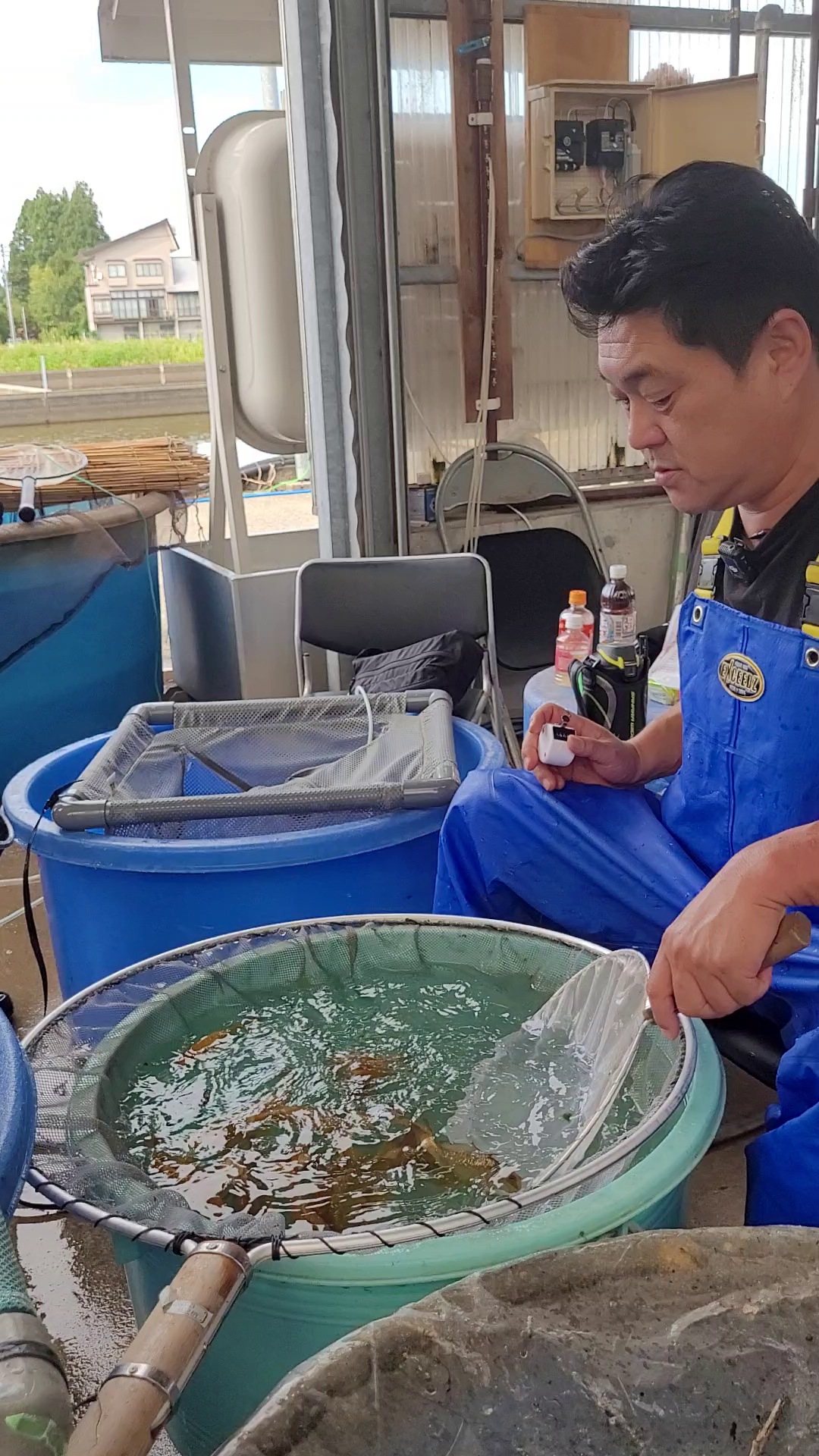
Sorting with Shigeru, episode 1. In September I sat with Shigeru Mano at the sorting bowl on the Dainichi Koi Farm and asked him how his Ginrin lines came about.
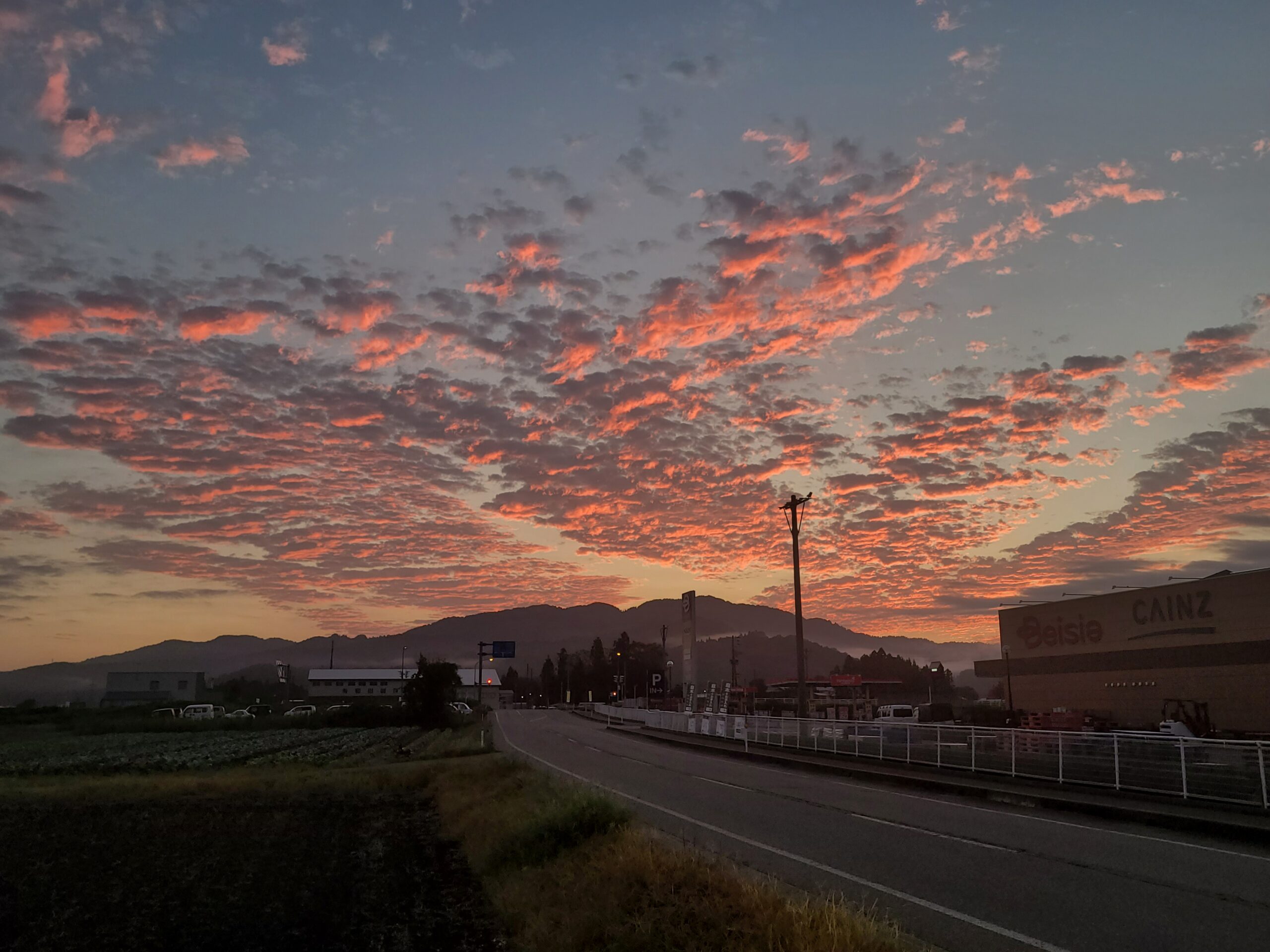
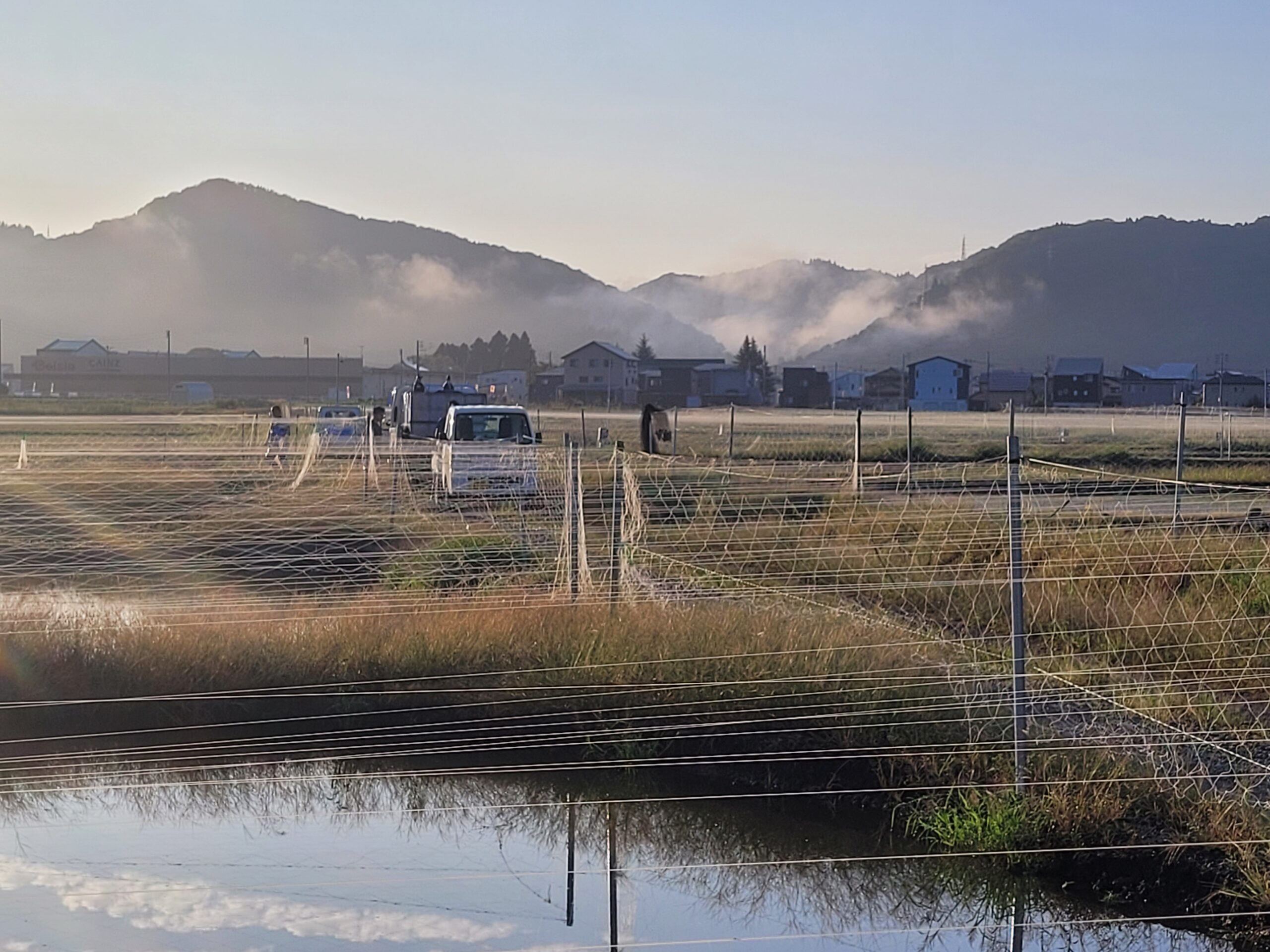
Early morning at the mudpond harvest, September 2026. Photo: Naoto.
The day on the farm starts at half past five. On the way there, the sky above the fields is just turning red.
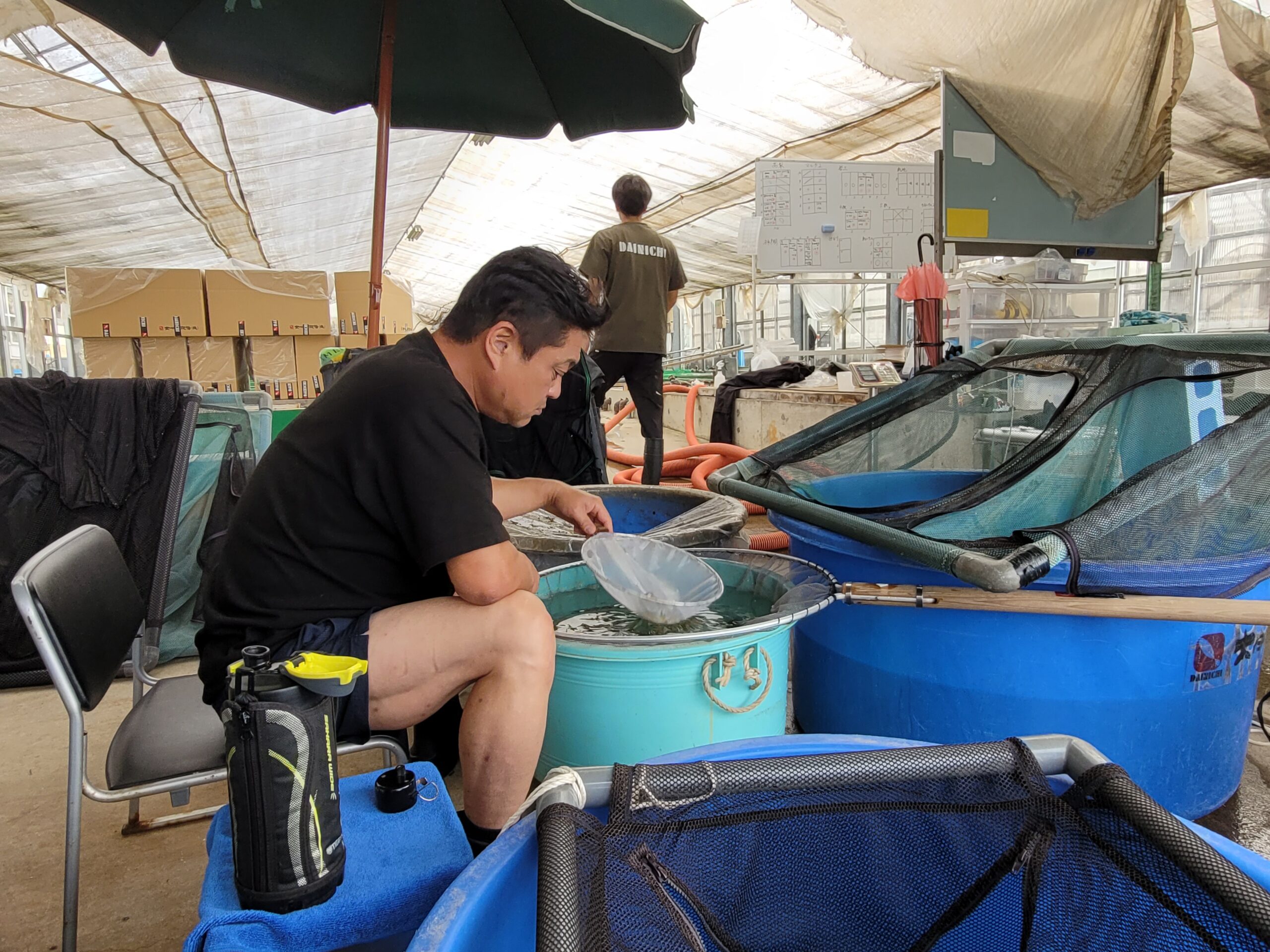
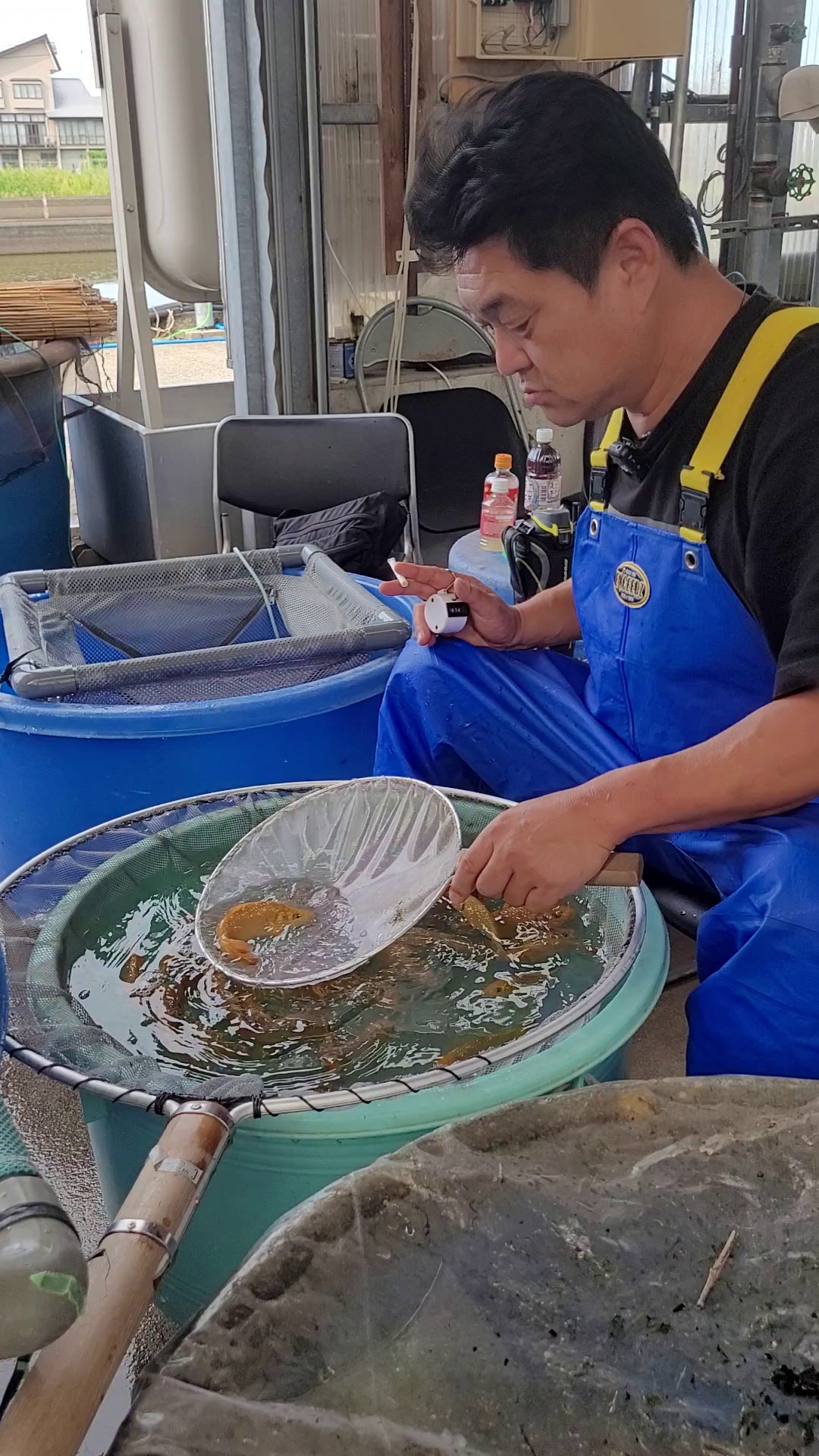
Sorting is the quietest work on a koi farm. The young fish go into the big bowl, and then each one is lifted out with the net, looked at and decided on: it stays or it goes. For hours, fish by fish. If you sit side by side doing this, there is time to talk, and that is exactly the time I used in September 2026. We spoke English, I asked the questions and Shigeru told his story.
One female, three males
It all began with the Botan line. I would have guessed that was fifteen years ago; Shigeru thinks it was more like eight to ten. The female was a Karashi from Sakai, the males came from Maruhiro, and there were three different ones. That was Maruhiro's advice: if you want to make something unusual, a special Kawari, you need unusual males, and not just one but at least three. Shigeru did exactly that.
Actually, he had a completely different goal. Maruhiro owned a beautiful Kinmatsuba Ogon at the time, and that was exactly what Shigeru wanted too. With a Karashi mother, Maruhiro warned, that would be difficult. A few Kinmatsuba did come out, but above all many other varieties that came from the female. Shigeru simply kept the unusual fish, a few Wagoi, a few Doitsu. There weren't many good fish among them.
But one of them is still swimming today: a big Doitsu of over 93 centimetres, once black and white, now completely white and with a very good body. It is now a parent fish for a new line, which is the subject of the next episode.
Shigeru has since given up on the Kinmatsuba Ogon. "As Tosai it looks good, as Nisai the shimi come up. As Sansai they're gone again, then they come back," he said. "It drives me crazy."
A Kohaku body in yellow
What made the Sakai Karashi so valuable back then was not its colour but its shape. Its body and face were close to a Kohaku's, with plenty of volume instead of the long body you usually see in Kawari. Everything that came from it rests on this shape.
Now it is the Yellow Monkey's turn, a Ginrin Karashi from this Sakai line, crossed with Kohaku. Next to other Ginrin Karashi it looks quite different once it grows: a different body shape, different growth, a different face. Shigeru also tried an ordinary Karashi female. The result was the body of an ordinary Karashi, and that is not what he wants.
Why yellow of all colours? "People like the yellow colour. So do I. And I like Ginrin," said Shigeru. On top of that, the fish grow strongly, get thick, eat a lot, shine and are lively. "It's fun to feed them."
"As Tosai, every fish looks like a Kawari. I'm looking for a big, powerful, shining body. That isn't easy."
Harder than Gosanke
Many people believe that breeding a good Kawari is easier than breeding a good Kohaku, Sanke or Showa. Shigeru disagrees. Precisely because a Kawari is usually a single colour, it has to grow big, grow strongly and have a beautiful body, otherwise there is nothing left to carry it. Making thin, long fish is easy. Nobody wants them, though.
Black today, yellow tomorrow
And then there is the unpredictability. One of the fish in front of us was completely black a month ago, then yellow and black, and now it is yellow. Into one pond he had put only black Chagoi, and they turned this colour. The scaleless Doitsu are almost white in the mudpond and get darker in the concrete ponds after the harvest. "Nobody can imagine that," he said. "That is really art. That's why I like Kawari."
For dealers this has a very practical side, and Shigeru and I quickly agreed on it. In autumn, many hobbyists ask whether their fish can stay with us until next year. With a Kohaku or Sanke that's no problem, every fish can be recognised by its pattern. But finding the one among a hundred Chagoi that has changed in six months? Without a chip it's impossible, and even then you have to check all hundred. A photo alone doesn't help much, since the fish keeps changing. The best bet is a precise picture of the line from the head to the dorsal fin, because that is like a fingerprint.
different males from Maruhiro were at the start of the Botan line.
mudponds are used by Shigeru today just for raising Kawari. It used to be two or three.
of foreign buyers in Niigata are looking for Kawari, in Shigeru's experience, and only 30 % for Gosanke.
Twenty-five ponds
I asked him how many mudponds he uses for Kawari. "To be honest, I've never told anyone that," he replied, because Dainichi is known above all for Gosanke. It's twenty-five. At the beginning it was two or three, back when he still thought Kawari were easy. He soon realised that wasn't enough, and today he is at twenty-five. But it shouldn't get any more. "That's enough. I have to make better Gosanke."
Because in fact he loves Gosanke. Every year he pairs seventy to eighty pairs of Kohaku, Showa and Sanke. All the more remarkable, he finds, is what is happening in Niigata today: buyers come from all over the world, and seven out of ten are looking for Kawari. "They're looking for something crazy, something different. I don't even know all the names."
First a code, then a name
You can see how a new line gets its name on the whiteboard in the greenhouse. At first there are only codes: DM, DYM, test 1 to 7, C1, K2. Only when a pairing lives up to its promise over the years does it get a real name. If you give it a name too early and the line disappoints, you have to change it again. Among the Showa, that line right now is Monroe. There is now Monroe Jr., and from Monroe Jr. another fifteen pairings. "Which one is good? Everything is a test."
Never finished
Finally, I wanted to know whether Shigeru has a plan for the next ten years, a goal he is working towards. "To be honest, I don't have a goal right now," he said. Every year: select, raise, look, try something new the next year. An Aragoke is always small, and he would like to make a big one. How, he doesn't know yet.
"What is a goal?" he asked back. "I think there is never a goal. Always think of something new, try, try. Get better, but never finished." That applies to Kohaku, Showa and Sanke just as much as to his Kawari. If it were easy to breed a really big, beautiful body, many could do it. But not many can.
More with Shigeru
The next episode covers the White Monkey, the second attempt at Black Zeus, the story of the Kujaku and the question of when Shigeru spawns artificially and when naturally.
 Deutsch
  Nederlands
  English
  Français