Black Zeus, Kujaku and the milt of the males
Sorting with Shigeru, episode 2. How culls turned into the White Monkey, why Shigeru is trying Black Zeus a second time, and when he spawns artificially and when naturally.
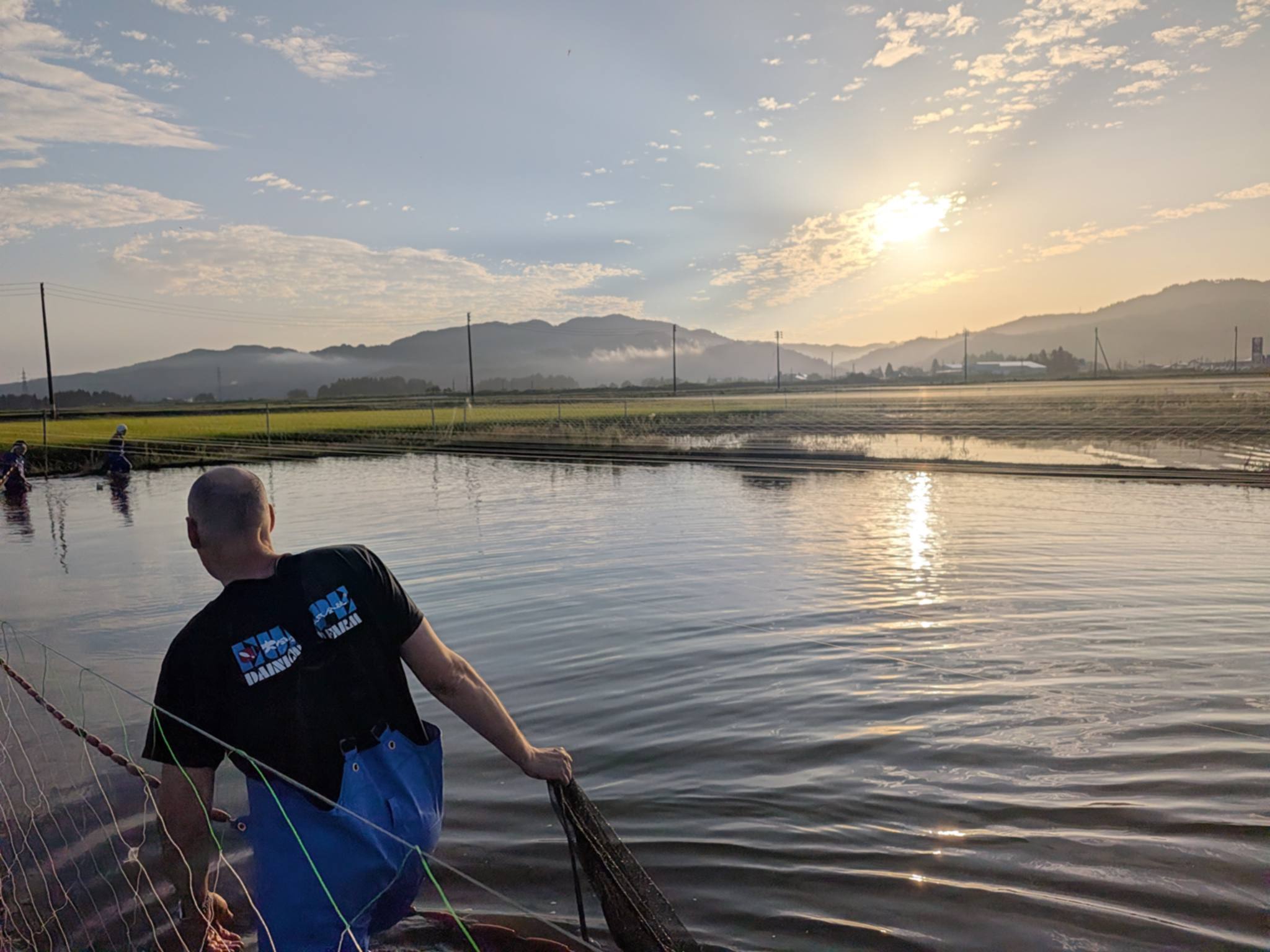
Harvest at the mudpond, September 2026. Photo: Naoto.
In the first episode Shigeru told how the Botan line, and from it the Yellow Monkey, came from a Sakai Karashi female and three males from Maruhiro. We were still sitting at the same bowl, and I wanted to know how things went on from there. Because in these lines a single pairing produces the most varied colours, from black to white.
One family, many colours
The names follow the colours. The Yellow Monkey is a Ginrin Karashi, the Brown Monkey a Chagoi, the White Monkey a white Karashi. So why aren't the silver-grey fish from the same family called Gray Monkey, instead of the long-winded Ginrin Soragoi? After all, I have to write that long name on the certificate every time. Shigeru has a simple answer: there are too few of them. A line only gets its own name once it produces enough fish.
What used to be culls
The White Monkey has a special story. "I used to throw away everything white," said Shigeru. White wasn't considered a colour; white fish were culls. Then large fish came out of some mudponds, Yellow Monkey, Chagoi, brown and white, and among them a white that was different: a deep, milky white with Ginrin. Shigeru found that interesting, sold a few, and people liked them. Since then he has kept them.
It reminds me of the beautiful Platinum lines of the past. A really good metallic Platinum line hardly exists today, and a white Karashi perhaps comes closest. Some fish from the white line have shown something very rare in our facility: the fish is white, only the shield of each scale turns brownish or grey, surrounded by a fine black line. I only had two or three of them, and they looked crazily beautiful.
"I used to throw away everything white."
Black Zeus, second attempt
The next generation from the Botan line is called Black Zeus: Aragoke, shining, Doitsu and Ginrin all at once, an unusual fish for which there isn't really a name. Shigeru made his first attempt six years ago and then stopped because it was so difficult. The customers who had bought Black Zeus back then grew them on, and after four or five years the fish showed what they were made of. Suddenly many asked: do you still have Black Zeus? He had none left. So he is trying again.
This time he is using as the mother the big white Doitsu mentioned in the first episode, over 93 centimetres and with a very good body. The Yellow Monkey is not part of this pairing.
I have seen in our own facility how much these fish change, with the Brown Monkey. Shigeru was just sorting type B with slightly larger scales. Before filming he had separated black and shining fish into two ponds, and the black ones had since turned a shining yellow-brown. With ours, the head turned grey-blue-black as Nisai, and the neck took on a rusty black tone too.
In the main house there is also a big Yamabuki, likewise from Dainichi's Kinmatsuba and Botan line. Whether it will be used for an Aragoke or for more metallic sheen is still open. "I don't know yet," said Shigeru. "I like it."
The Kujaku and their story
There is also a big Kujaku with plenty of volume swimming in the greenhouse. It doesn't come from Shigeru's own breeding but from Konishi. Shigeru used to breed Kujaku himself, but hardly any variety is as difficult: body shape, volume, metallic sheen, pattern and the Matsuba marking of the scales all have to be right at the same time.
It reminded me of a story I told Shigeru, one he didn't know himself. Twenty or twenty-five years ago there was a breeder in Hiroshima called Yamada who made very special, beautiful Kujaku. When he gave up his farm, his mudponds and parent fish went, as I remember it, to Konishi, and from there some fish came to Omosako, who then began breeding Kujaku himself. In Konishi's harvest photos you can still see old Mr Yamada in the background, helping to harvest his former ponds.
What does Shigeru plan to do with the Kujaku? Cross big white females with Yellow Monkey and Kujaku, because the two differ in sheen. The Yellow Monkey has Ginrin but no sheen. The Kujaku shines. The aim is something new: Doitsu and Ginrin at once, plus a shining colour tone. It won't be easy. "Just try," he said.
of his spawnings Shigeru now does artificially, the other half naturally.
is how often a male is used in natural spawning over a spawning season of about 50 days.
is the size of the white Doitsu with which Shigeru is rebuilding Black Zeus.
Artificial or natural
Finally, we talked about how the fish actually come together. I know very different approaches. I know that Omosako used to divide the eggs of one female into five or six portions and fertilise each portion with the milt of a different male, so that he knew exactly which mudpond came from which father. Sakai pairs individually, one male with one female. Dainichi, on the other hand, always seemed to me one of the big farms that tend to spawn naturally, with two or three males.
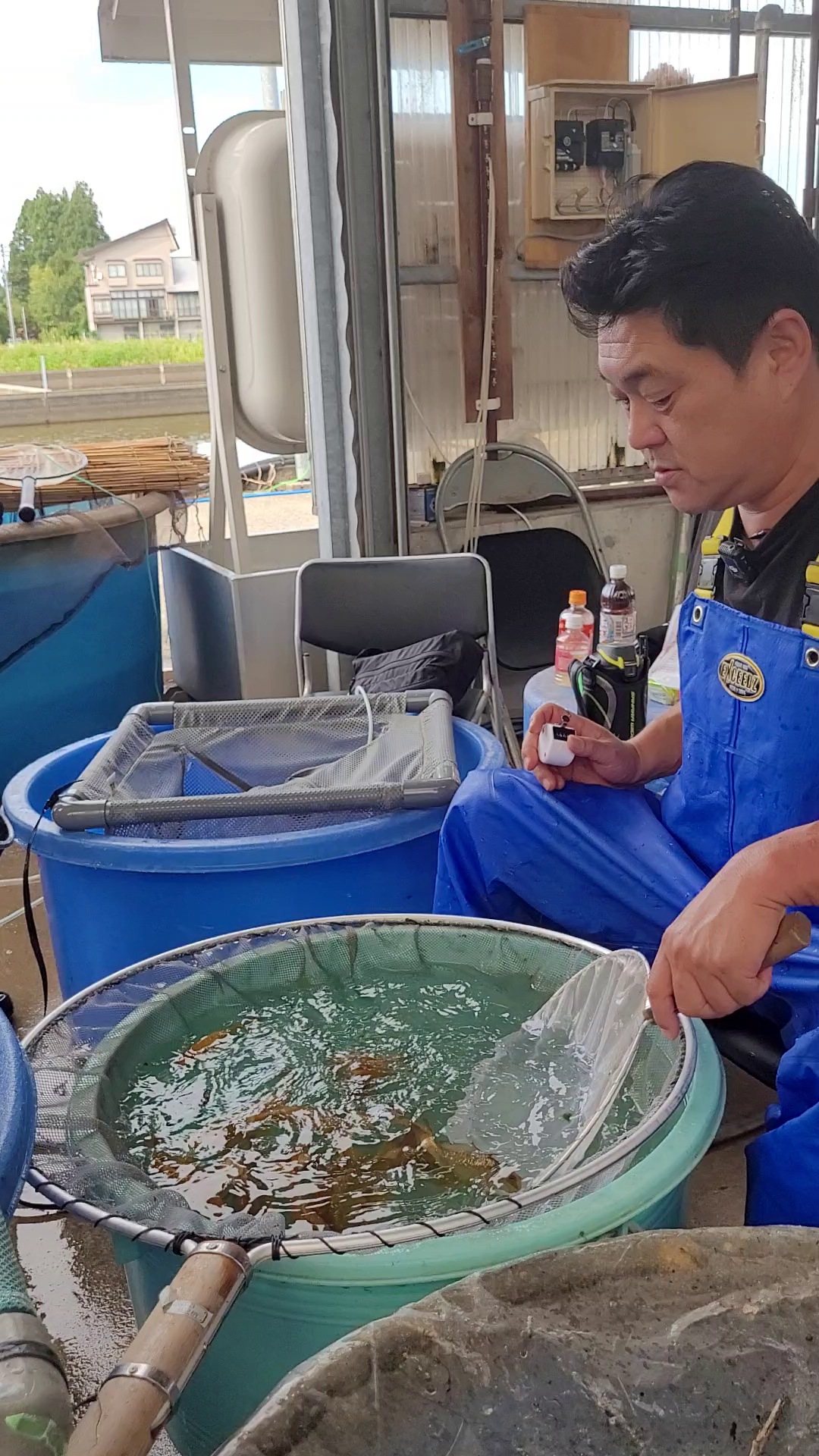
That is no longer quite true. Today it is half and half: sometimes a single male, sometimes two or three, sometimes artificial, sometimes natural. Shigeru rejected my guess that he spawns the most important lines artificially to be sure of their parentage. He decides in the moment, by feel, depending on the female and the male. For artificial spawning he only uses small males.
And then there is the milt. In natural spawning a male can be used about seven times in a season, artificially even more than ten times, but only if enough milt comes. Sometimes nothing comes the second time, even with a really good male. Then you wait a week, feed a lot and try again. "The milt is very important," said Shigeru. "Without plenty of milt it doesn't work."
Sorting itself is, by the way, more tiring with Kawari than with Gosanke. There is no pattern for the eye to hold on to, and the body shape is hard to see in the young fish. It takes a lot of strength and a lot of eye work to find the right fish. On that, Shigeru and I agreed.
More with Shigeru
The last episode is about the question that stands above everything: body or pattern? Plus a Grand Champion for 50,000 yen, my green fish from Maruhiro and why Ginrin Showa doesn't pay.
 Deutsch
  Nederlands
  English
  Français