I have known the Torazo Koi Farm for three generations. In September 2026 I travelled there with Professor Harry Palm so that he could hear its stories first-hand.
Tsuyoshi and me at the harvest, October 2013.
Harry researches aquaculture at the University of Rostock, and he wanted to know what the koi trade looked like before there was oxygen and plastic bags. Tsuyoshi Kawakami also has an old book that he simply had to see.
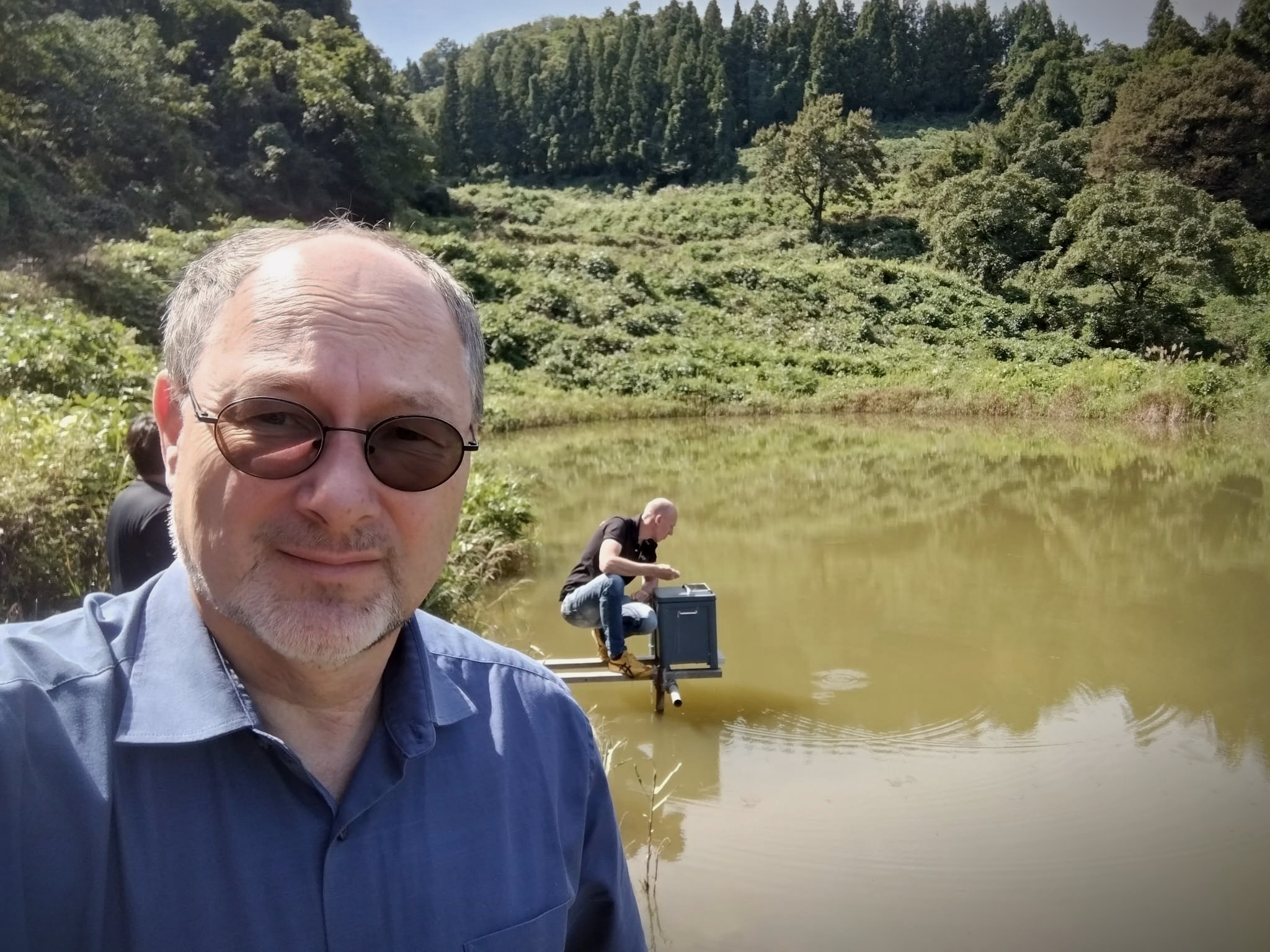
Harry Palm on our trip, with me feeding the koi in the background. Japan, September 2026.Tsuyoshi Kawakami in conversation with Prof. Harry Palm, September 2026. We speak English with Tsuyoshi, with German subtitles.
Three generations
The farm is named after Tsuyoshi's great-grandfather Torazo, who did not yet breed koi himself. Breeding began around 1917 with his grandfather, Torakichi Kawakami. He released the larvae into the rice paddies and was one of the first to produce Sanke with strong red markings. He obtained the red, just as Kobayashi did with his Showa, by crossing in a Tomoin Kohaku.
My first deals were still with Tsuyoshi's father; Tsuyoshi himself was mostly in the background back then. At some point he took over the farm. At the time I was looking for a new agent to handle my freight, and that is how we grew closer and closer.
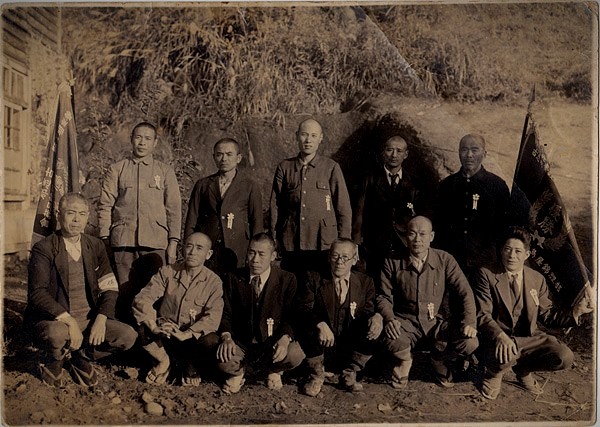
Koi breeders from Urakawa in an old group photo. Front row, far left: Tsuyoshi's great-grandfather. Back row, far right: the breeder Kobayashi (Kobayashi Showa).
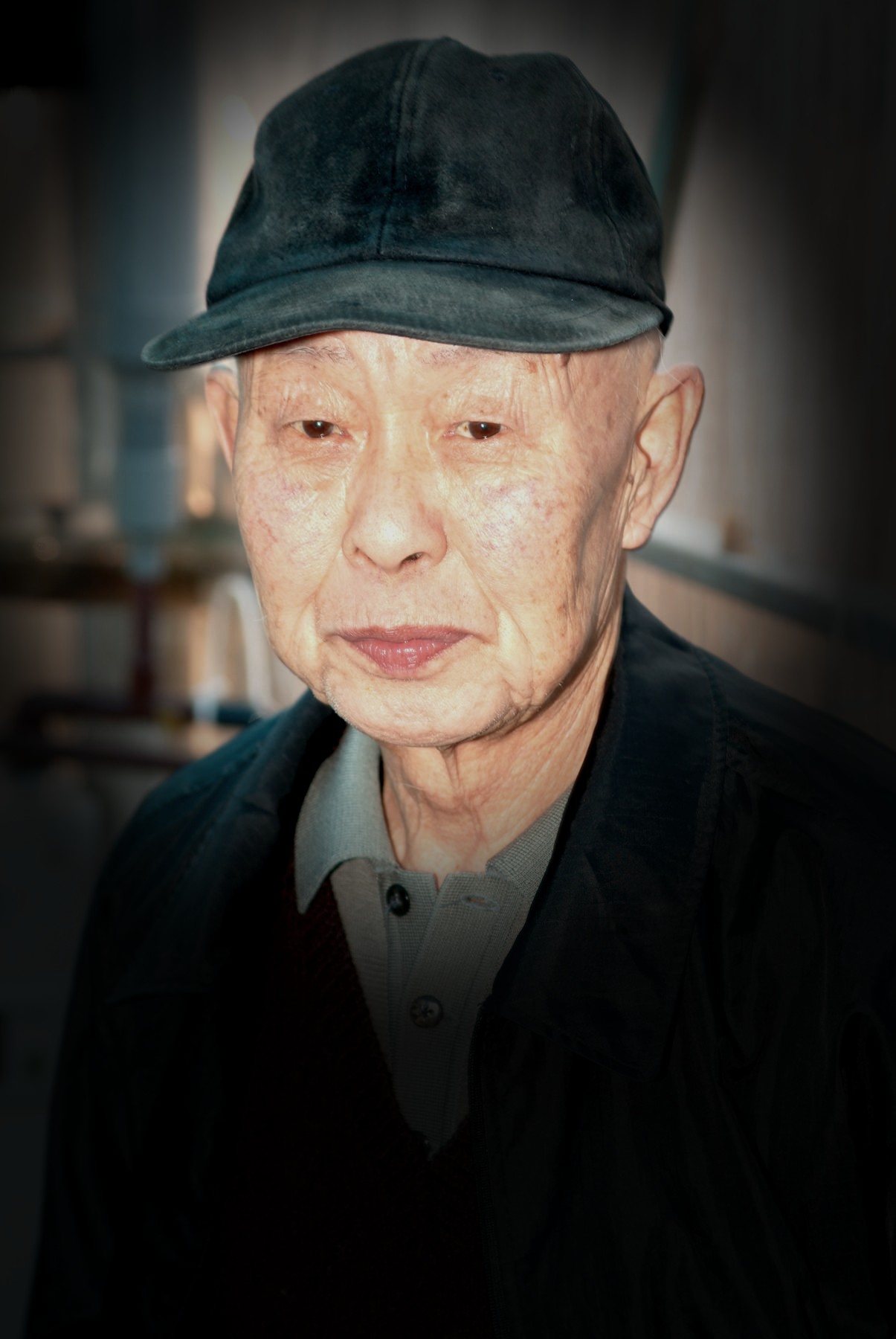
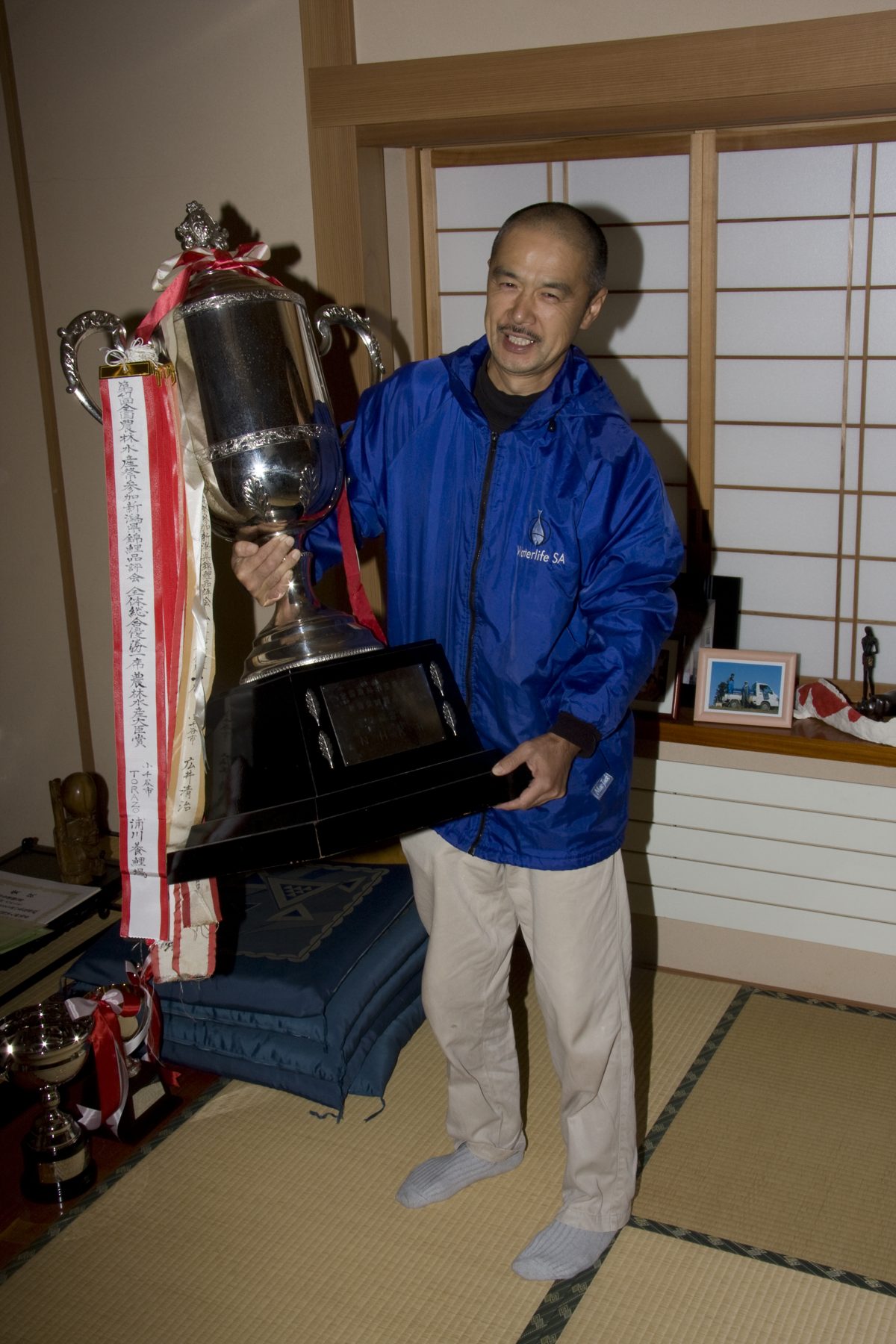
Left, Tsuyoshi's father, with whom I did my first deals. Right, Tsuyoshi Kawakami with a Grand Champion trophy from the Niigata prefectural show.
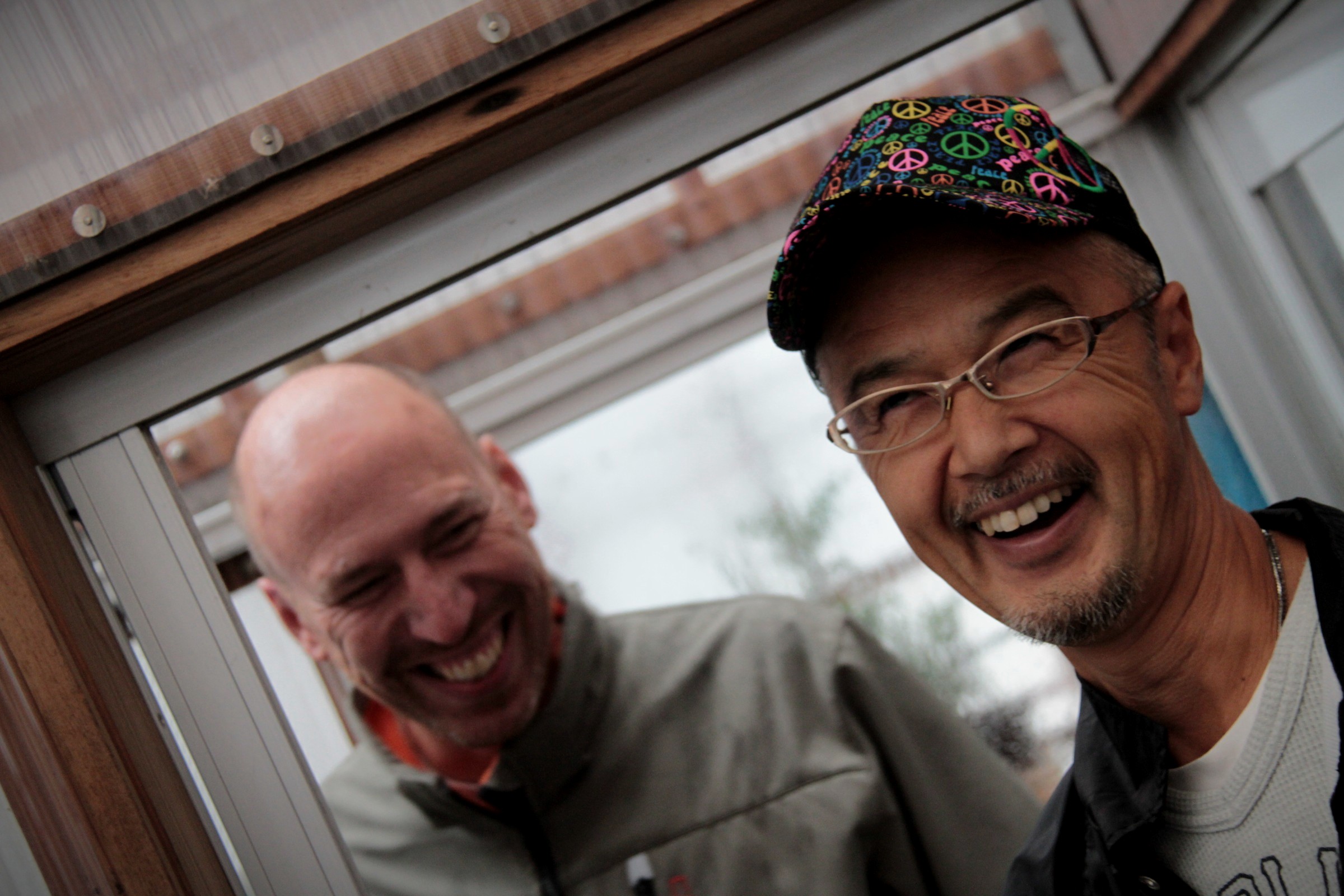
Tsuyoshi and me, 2013. Photo: Johann Leurs.
Once in Japan I was standing behind two koi dealers – Englishmen, I think – and couldn't help overhearing them talk about Tsuyoshi. "You never see him laugh," said one, "he's always so grumpy."
To which the other replied: "Unless the big German is around."
I had to smile. It is one of the nicest compliments I have heard in all my years in Japan.
senbetsu選別
First pick from the truck
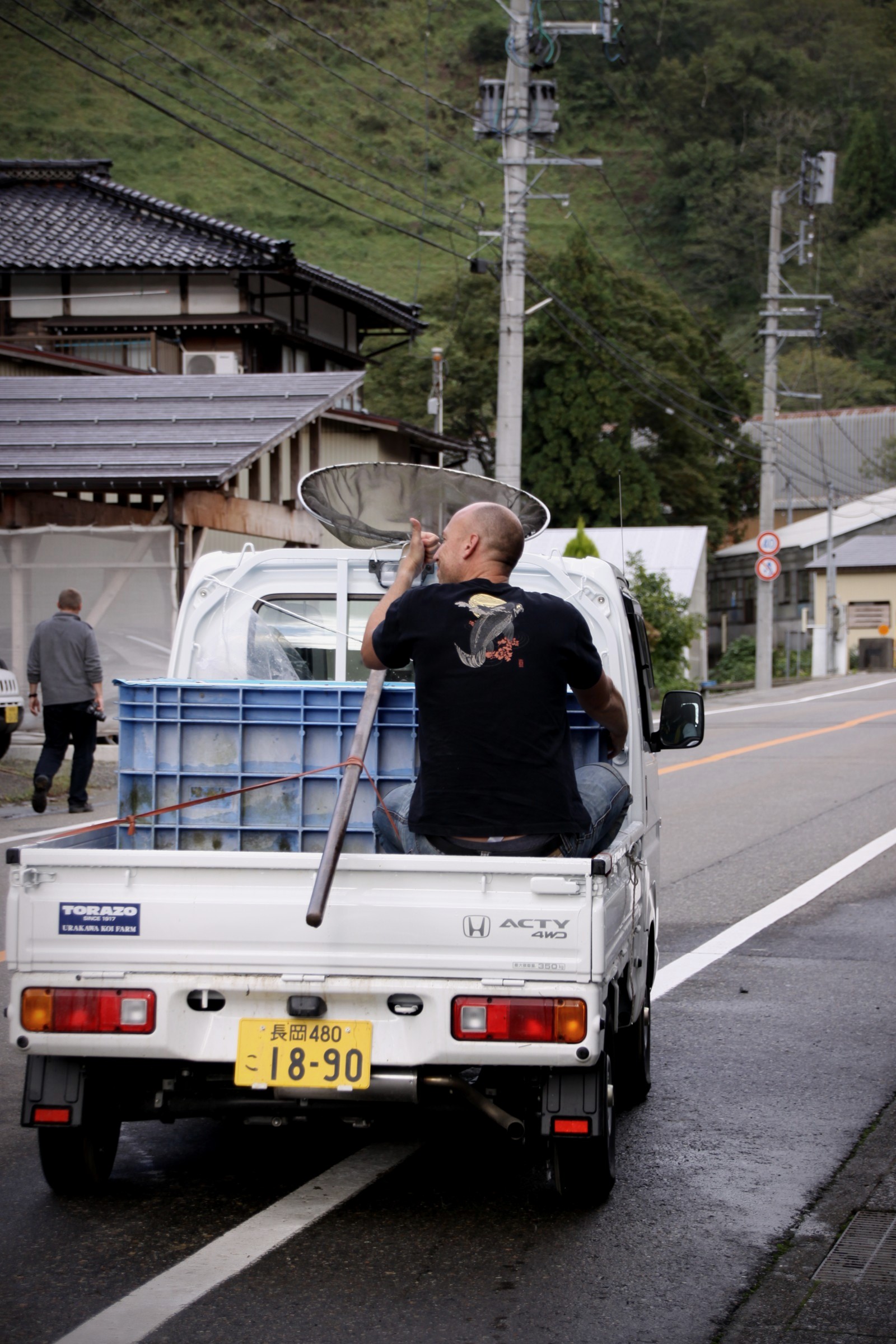
Around 2005 I helped harvest the Torazo ponds for the first time. Torazo is one of the first breeders in Niigata to harvest. Back then the harvest started on 4 or 5 October and was finished around the 15th. Nisai, Sansai, Yonsai and older fish – everything was brought in, and it was always great fun.
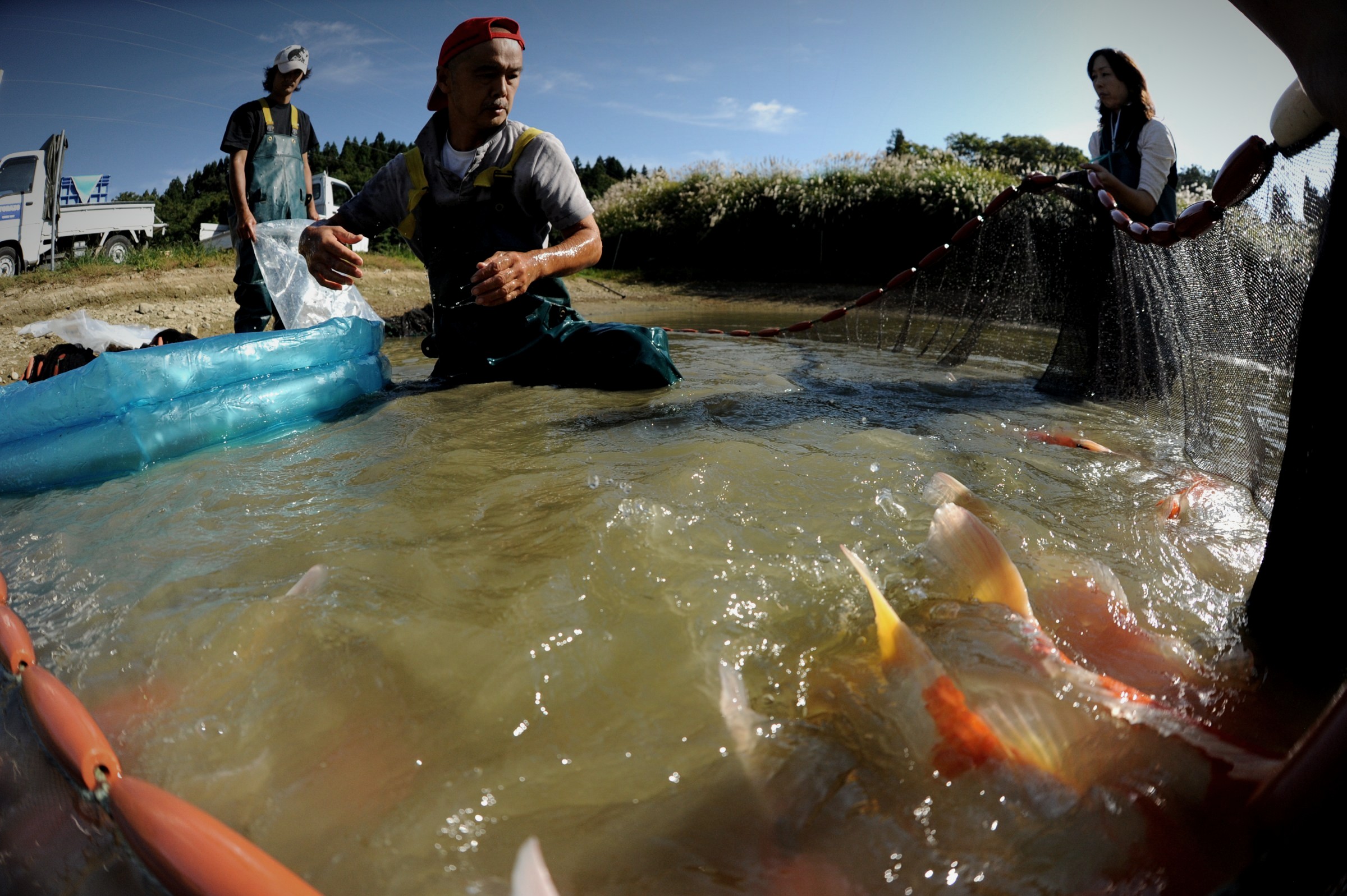
Early in the morning I drove out to the pond with Tsuyoshi. We pulled the seine net through the pond, took the fish out of the net in plastic bags, carried them up to the truck and put them in. Then we hauled in the net, cleaned it, loaded it back up and drove back to the farm with the fish and all the equipment, where the koi went into the concrete tanks.
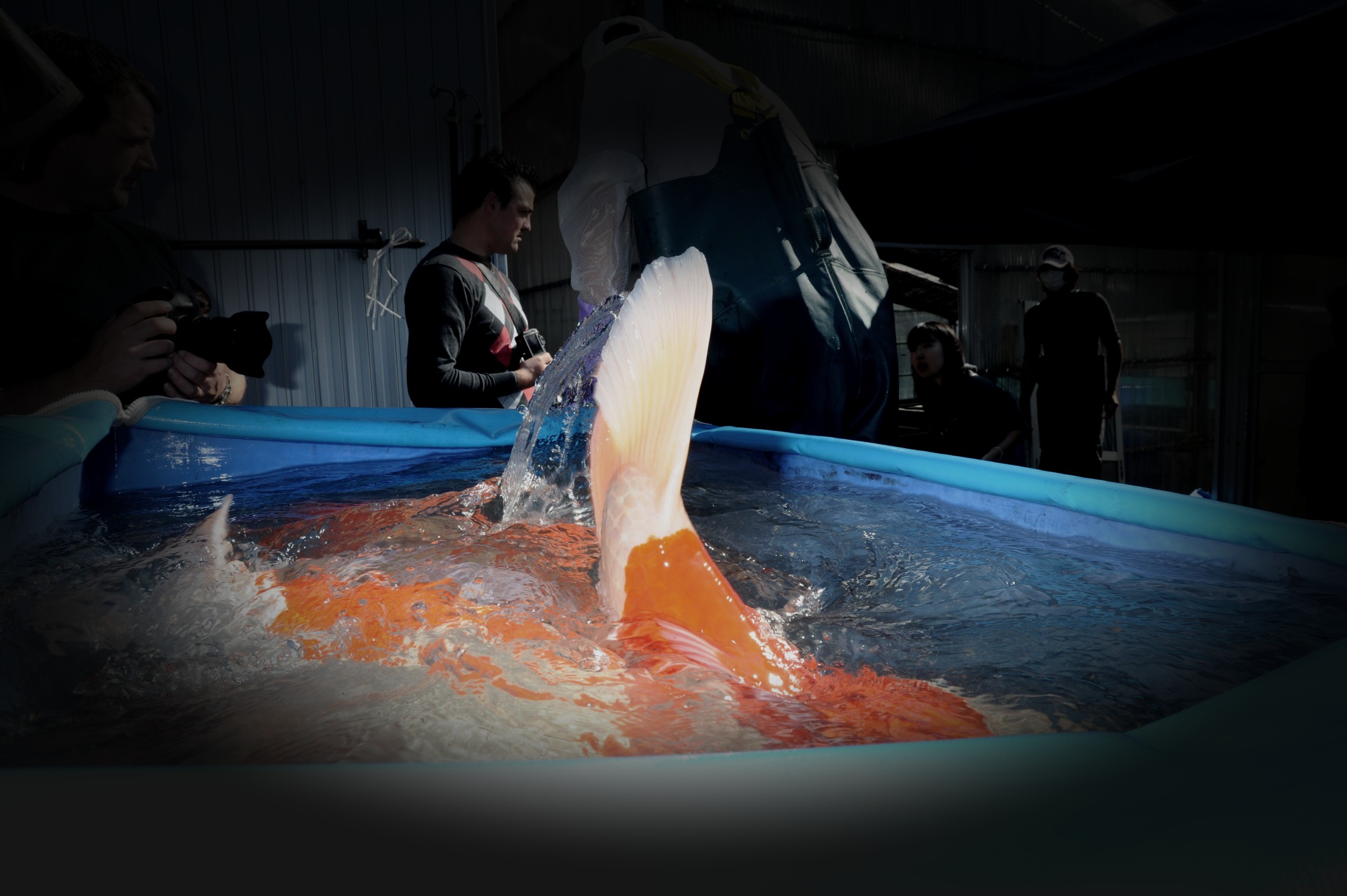
Dealers from all over the world were already waiting at those tanks. Because I had worked along for hours and had been there from the start, I had the privilege of being the first to say: I'd like that one, and that one, and that one for my own shop. I could make my choice before anyone else in the world.
Torazo, 2012: the seine net is drawn in.
Today, on many farms the order of choosing is drawn by lot or played for. Each dealer may take one fish, then it's the next one's turn, round after round. A whole day goes by for one or two fish. Some dealers go along with it, but it's not for me at all.
Torazo, 2012.
1917
Torazo has been breeding in Urakawa since that year.
3 days
That's how long the train journey to Kyushu used to take, in a wooden box and without oxygen.
9 out of 10
Almost that many nishikigoi go abroad today.
A hotel for koi and for dealers
Today almost nine out of ten nishikigoi go abroad. When Tsuyoshi was a child, six or ten years old, they all stayed in the country, he told us. The customers were dealers from Shikoku, Kyushu and Hiroshima. Every morning they drove to the villages in the area, bought fish and put them in the Kawakami family's outdoor tanks.
Up to twenty-five dealers lived in the house at the same time. Tsuyoshi's mother and a few helpers cooked breakfast and dinner – miso soup, rice, a little fish – and after dinner they played cards for a lot of money. "Like a hotel, a koi hotel," said Tsuyoshi. "Crazy, really crazy."
Three days in a wooden box
There were no plastic bags or oxygen back then. The fish travelled in wooden boxes of water by train, and it took three days to reach Kyushu. Whoever travelled with them shook the water along the way to let air in. Many fish did not survive the journey. The rest were tough – smaller, slimmer and stronger than today's koi. "No oxygen," said Tsuyoshi, "and still they lived two, three days in a small wooden box."
The first from Europe
Buyers from abroad only came later. One of the first European koi dealers was Peter Waddington. He and I had the same agent, Mr Takahashi from Chiba, one of the best-known dealers of his time. Many customers came to Torazo through him, and I too was there with him on my first visit.
Why here of all places
Harry wanted to know where all this came from. "Because of all the snow," said Tsuyoshi. The mountains of Niigata get more snow than almost anywhere in Japan. Carp were a store of protein for the long months, kept in wooden boxes in spring water, often right under the house. If a fish stood out – red fins, red cheeks, somehow different from the others – it was kept and bred from the following year. Over generations, these oddities became a breeding tradition.
There is also a German chapter. In 1910 the Tokyo port authority had the first German mirror carp imported. That is why scaleless koi are still called Doitsu today. They grew noticeably faster than the Japanese carp.
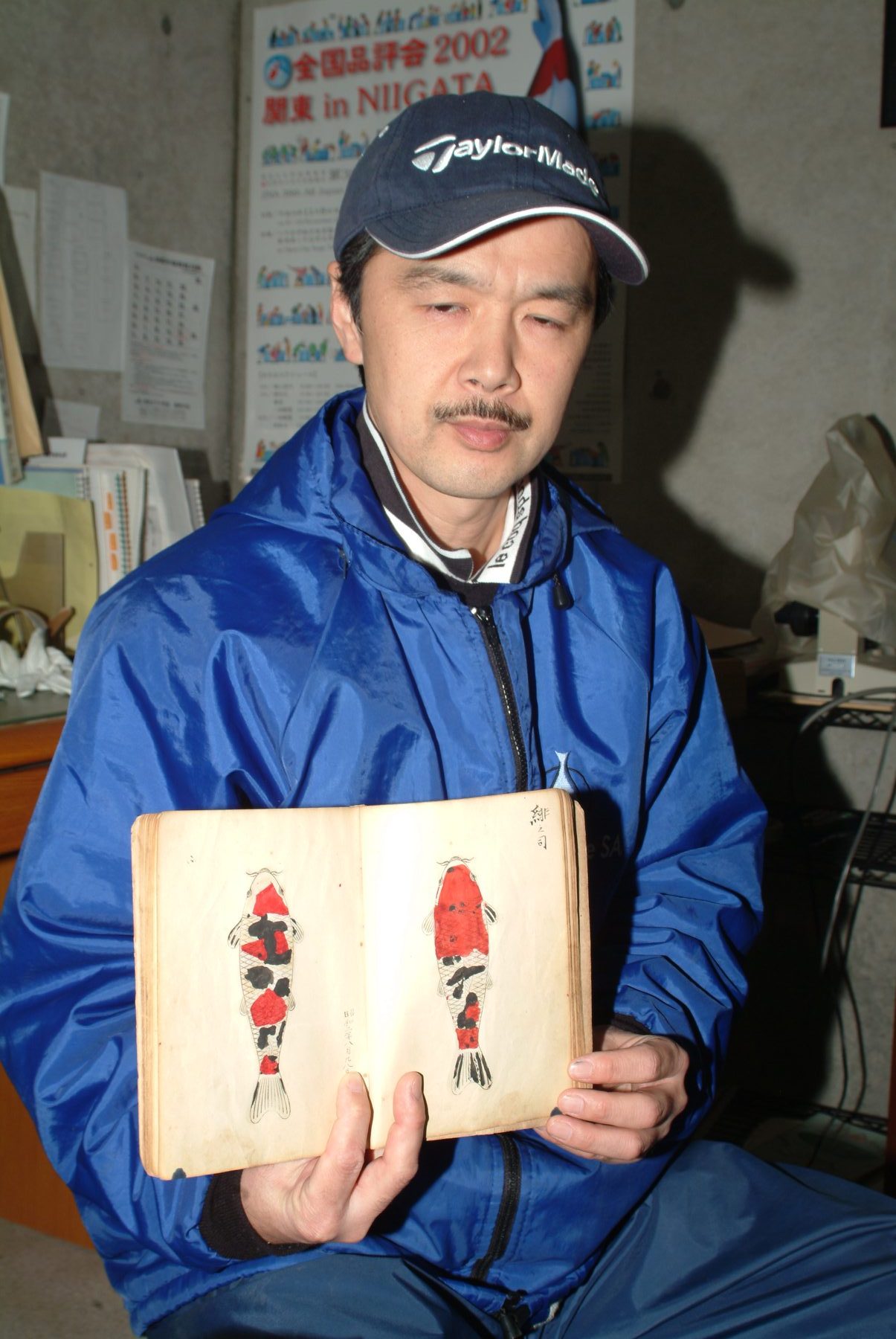
Tsuyoshi Kawakami with his grandfather's book.
The grandfather's book
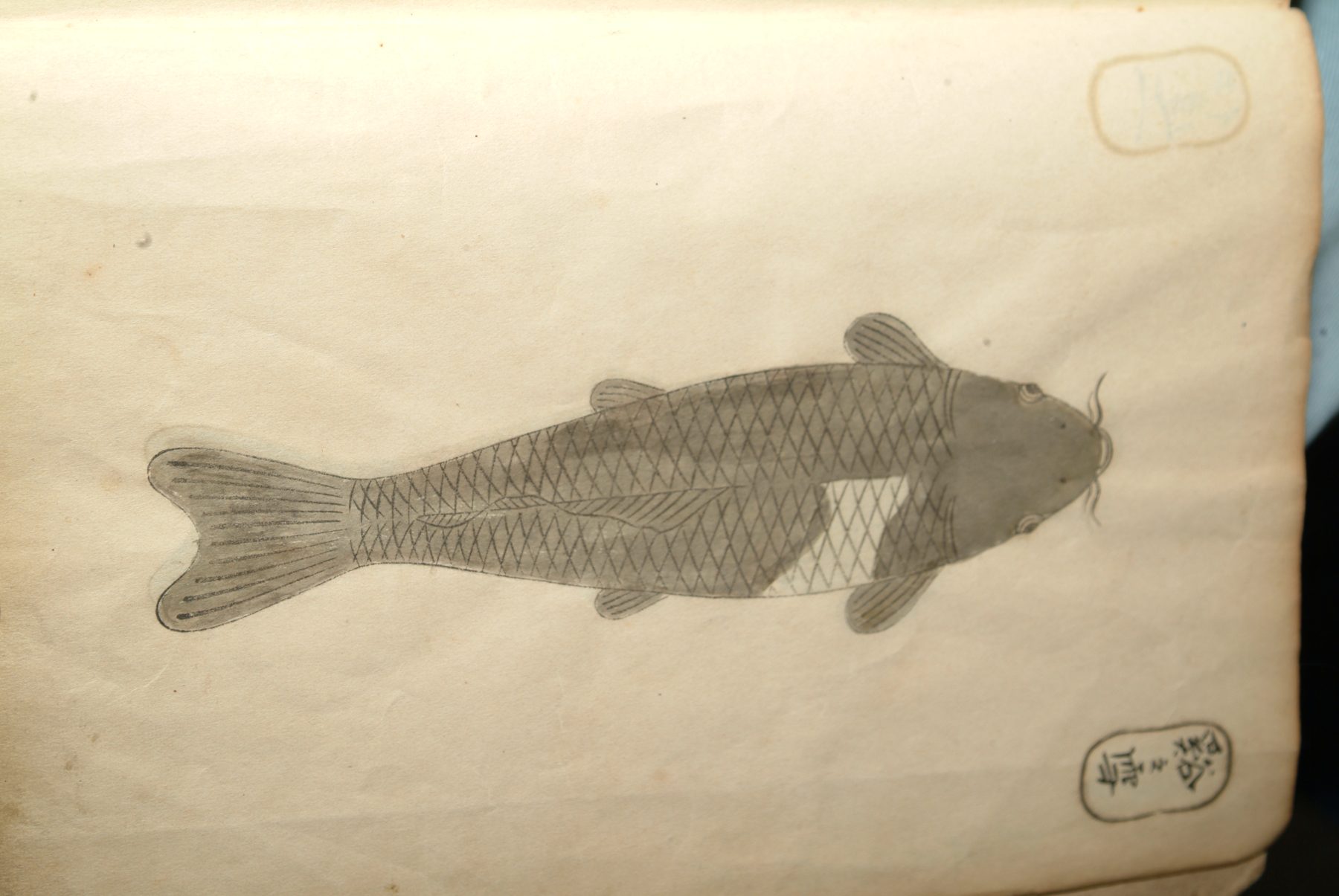
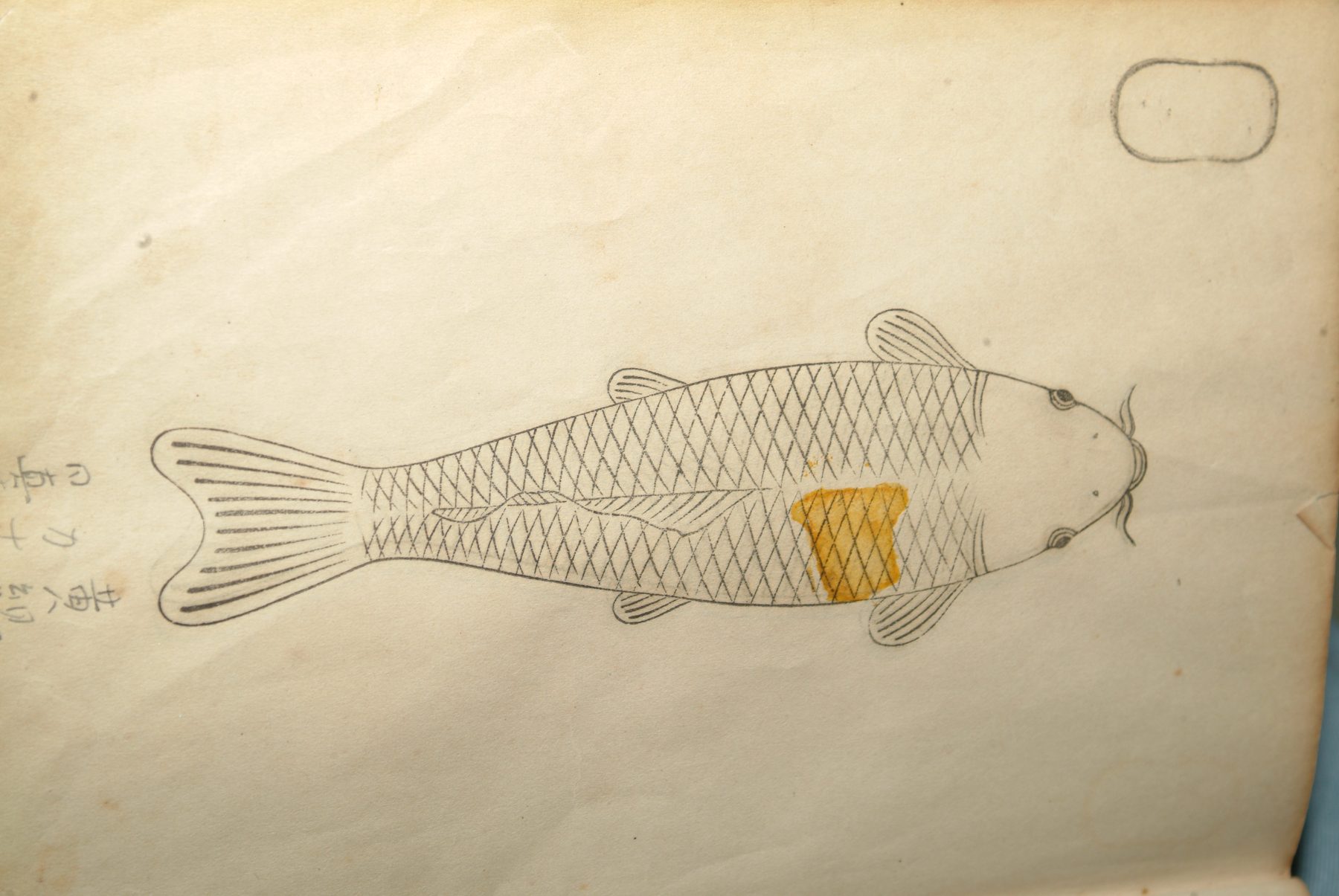
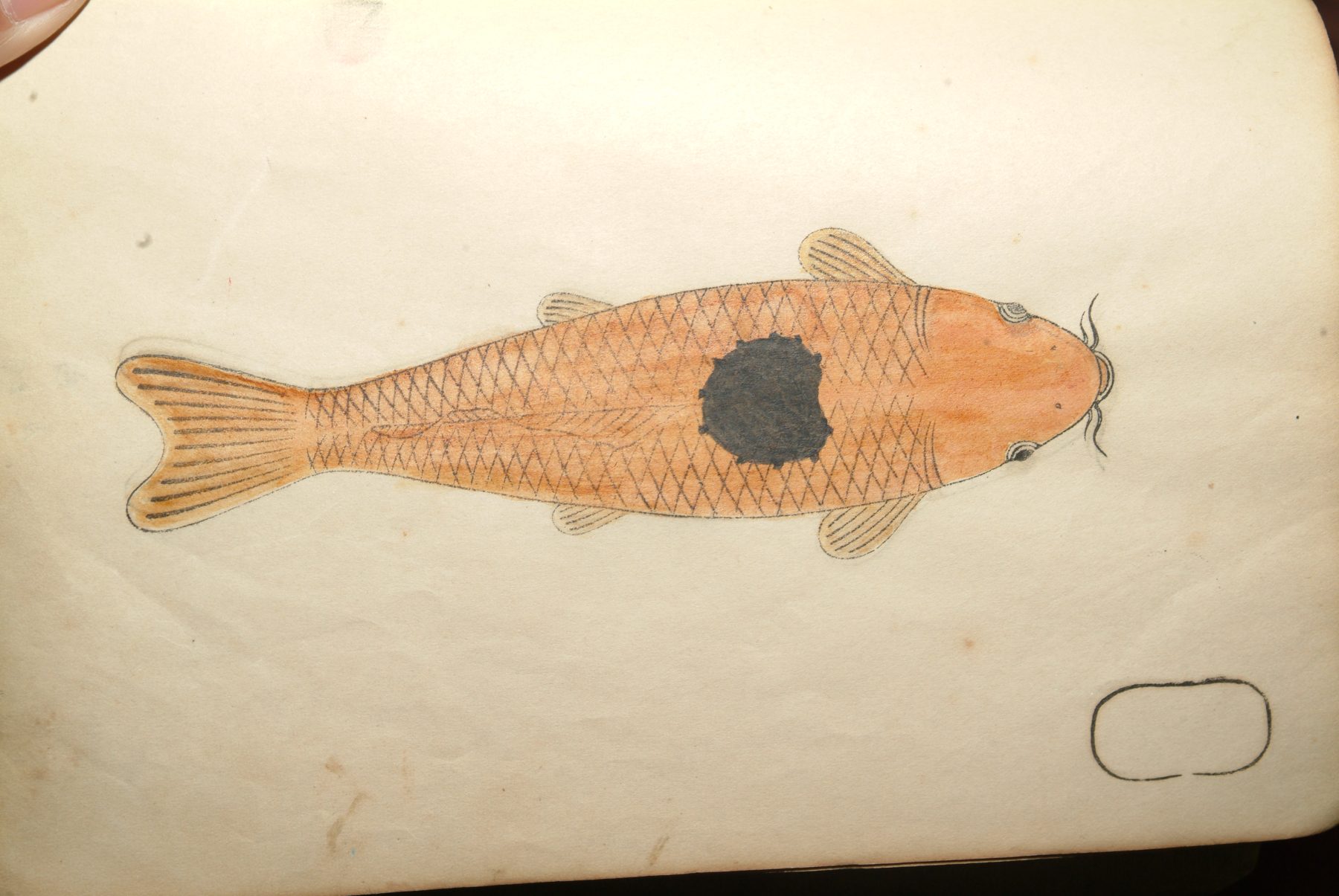
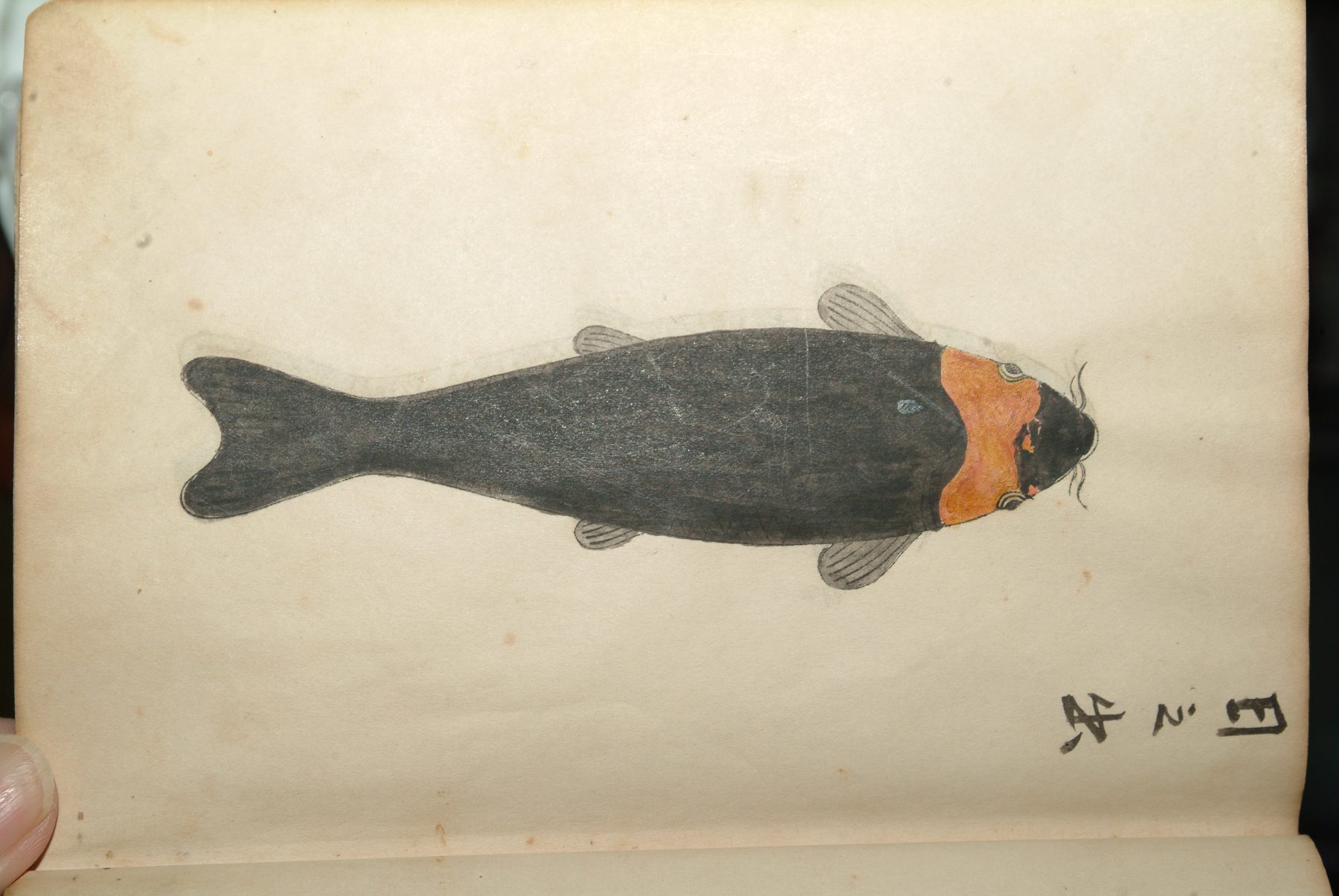
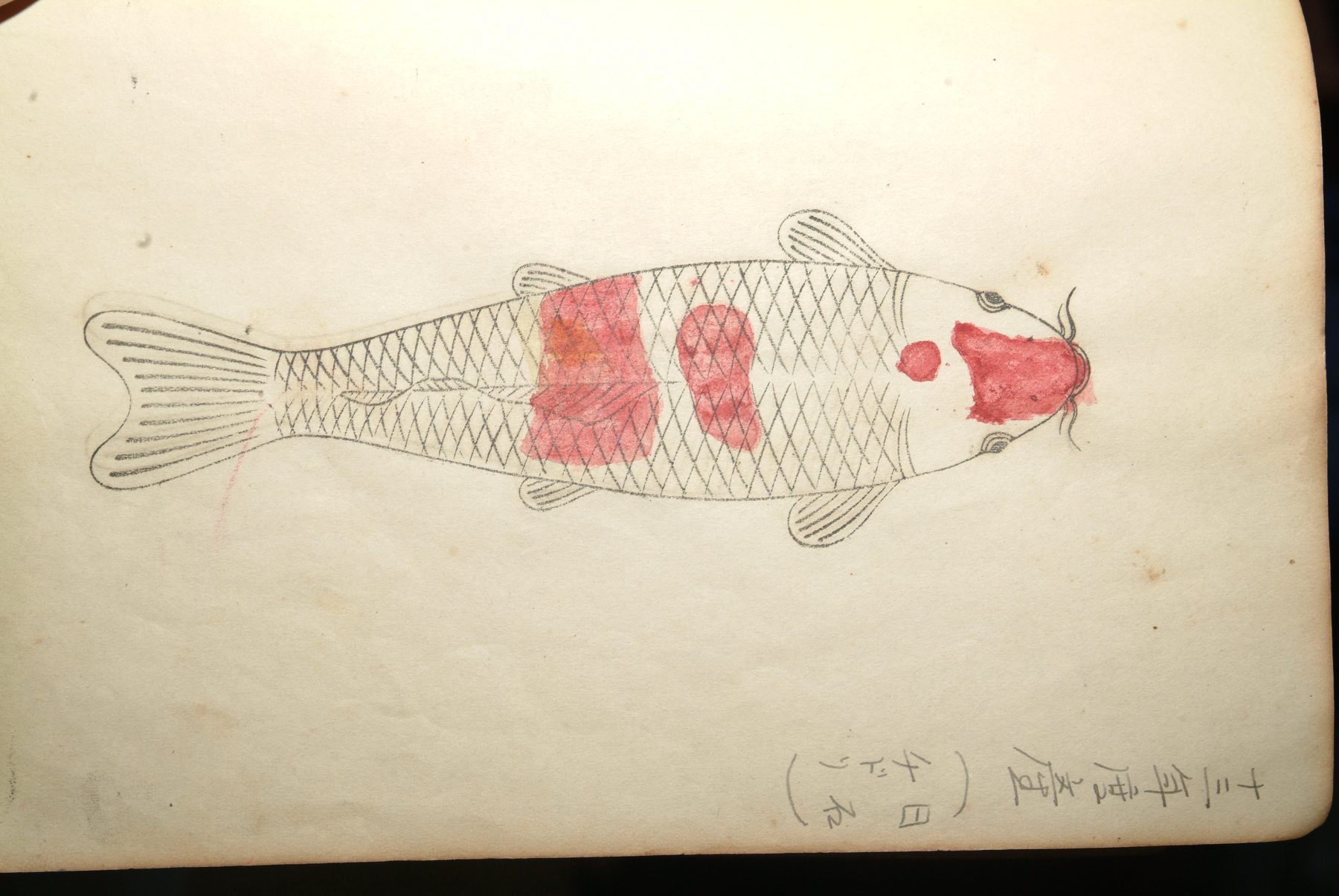
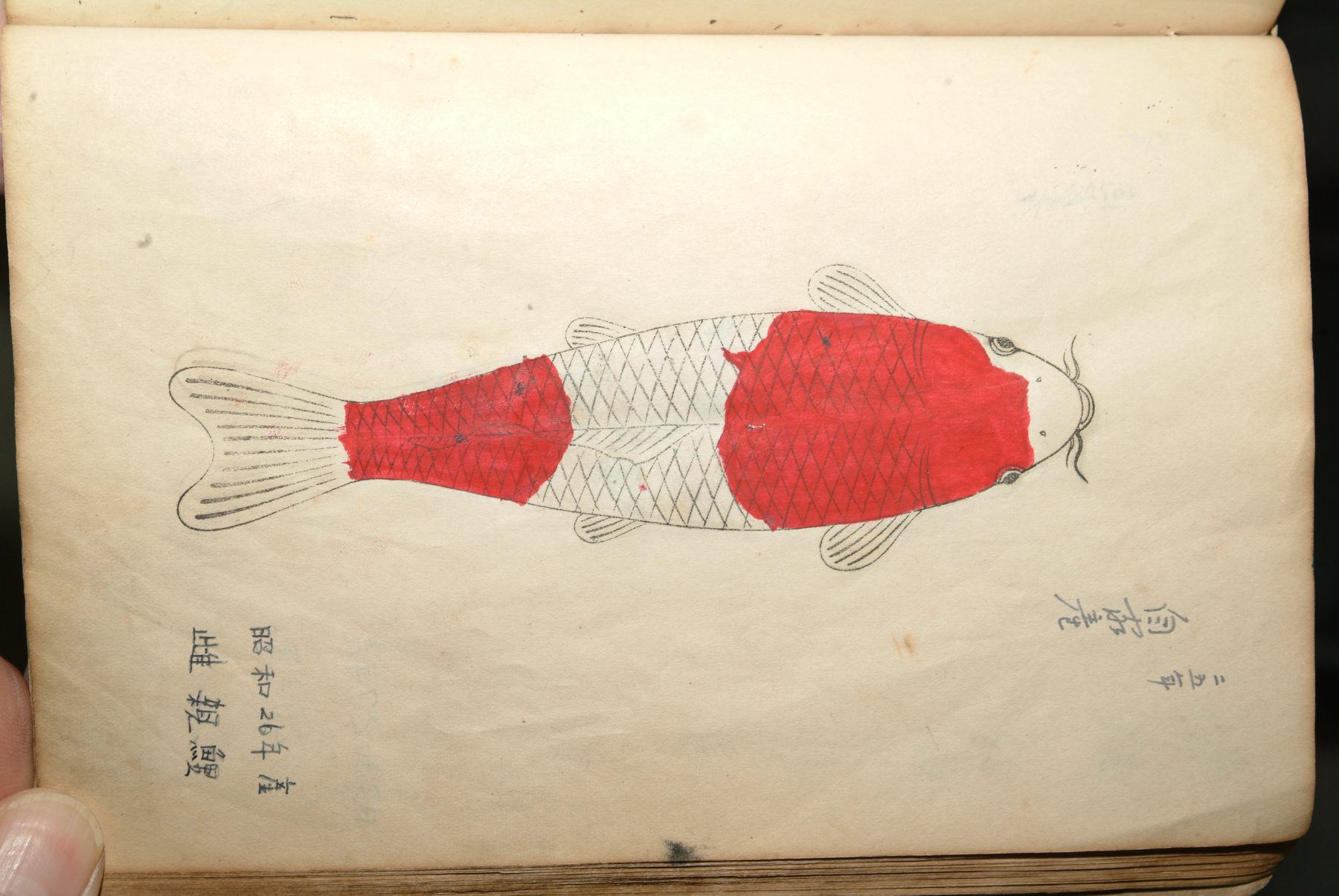
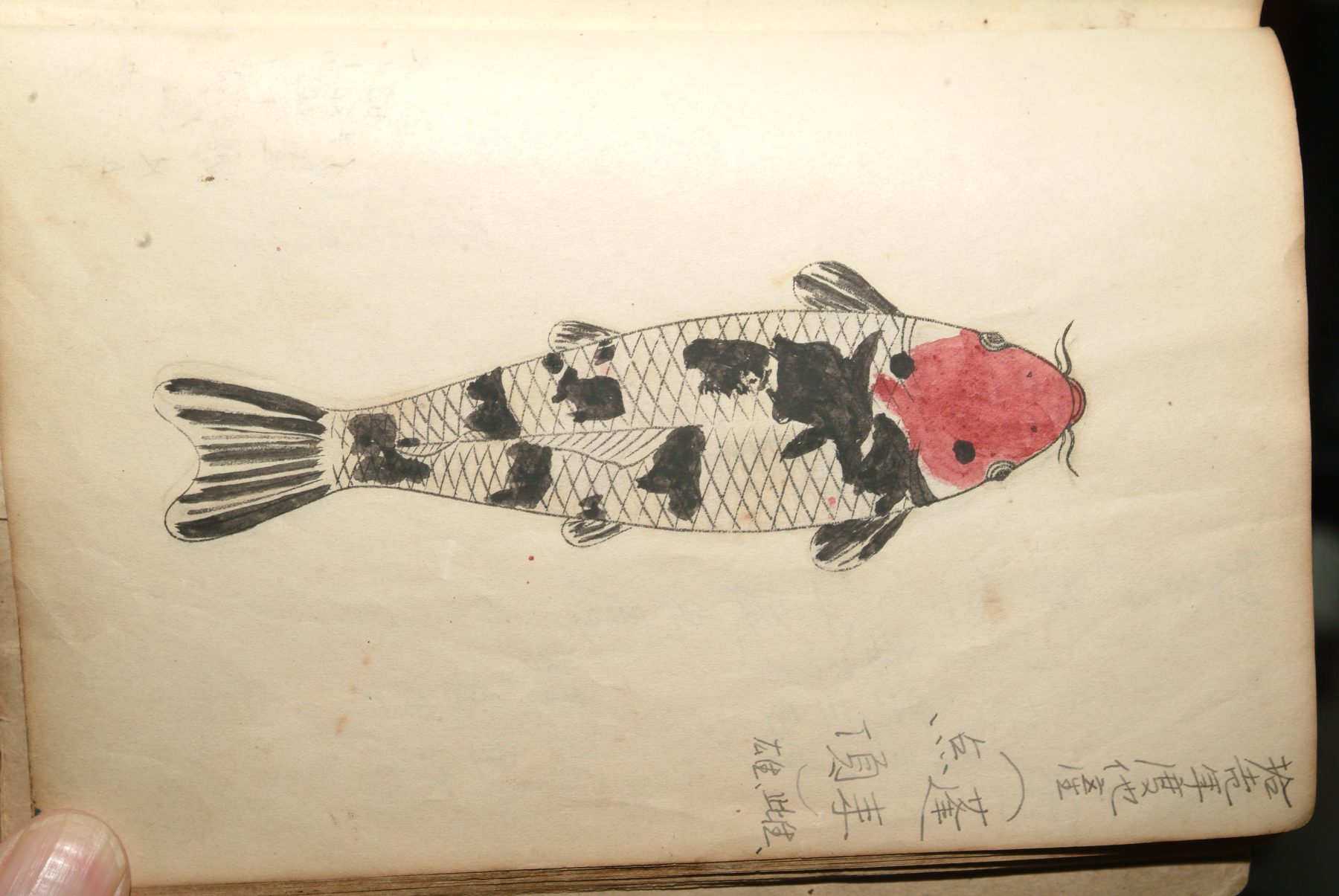
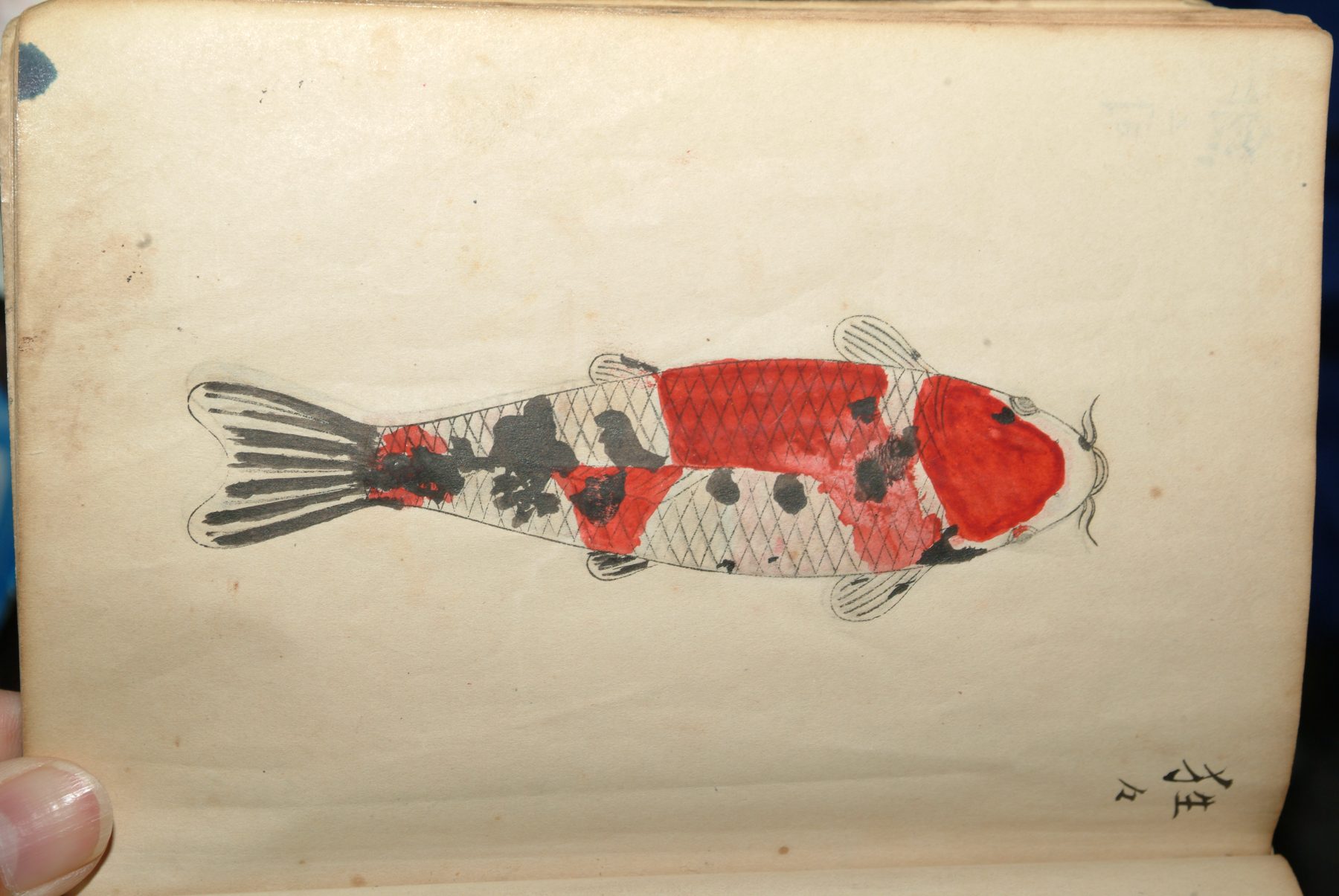
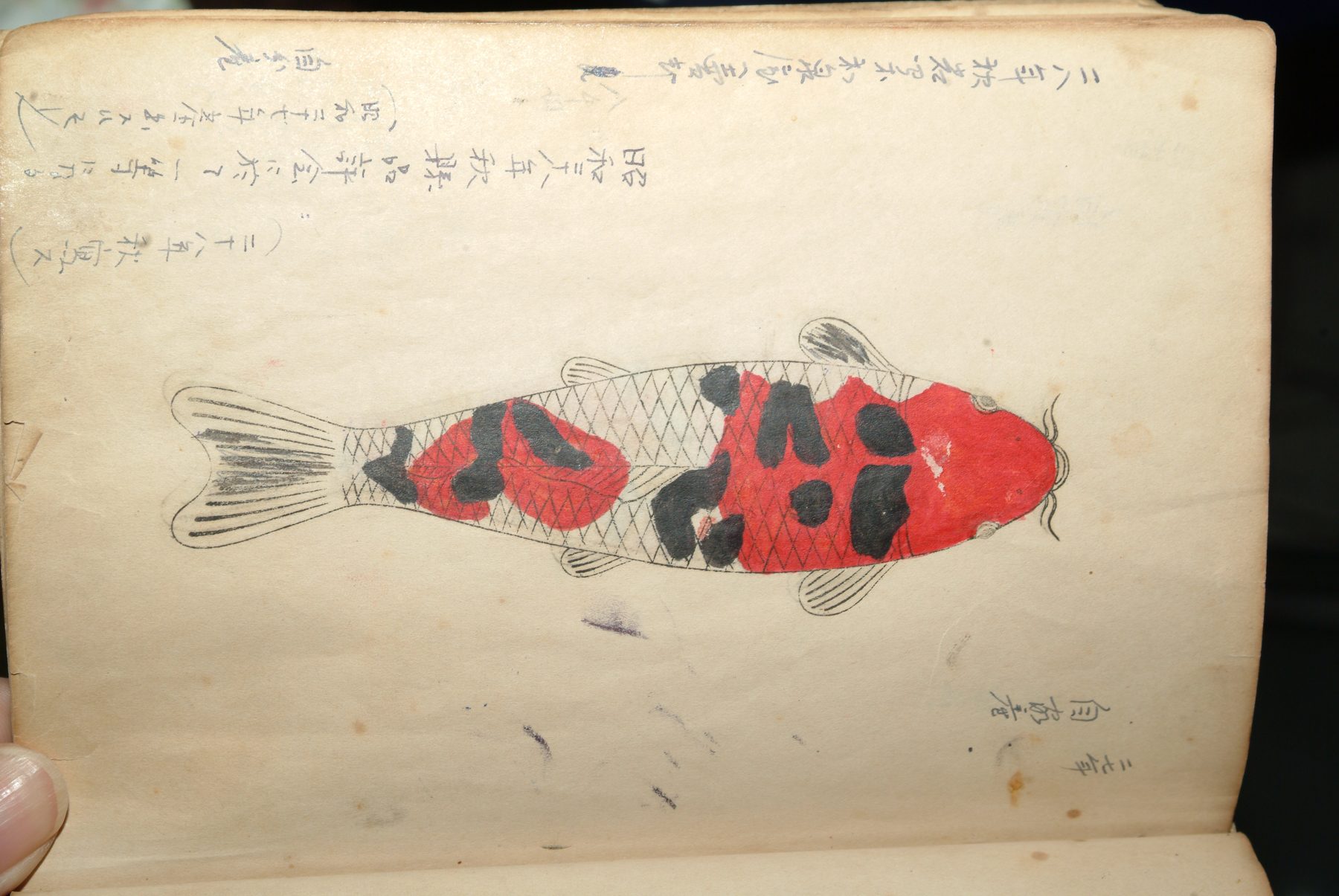
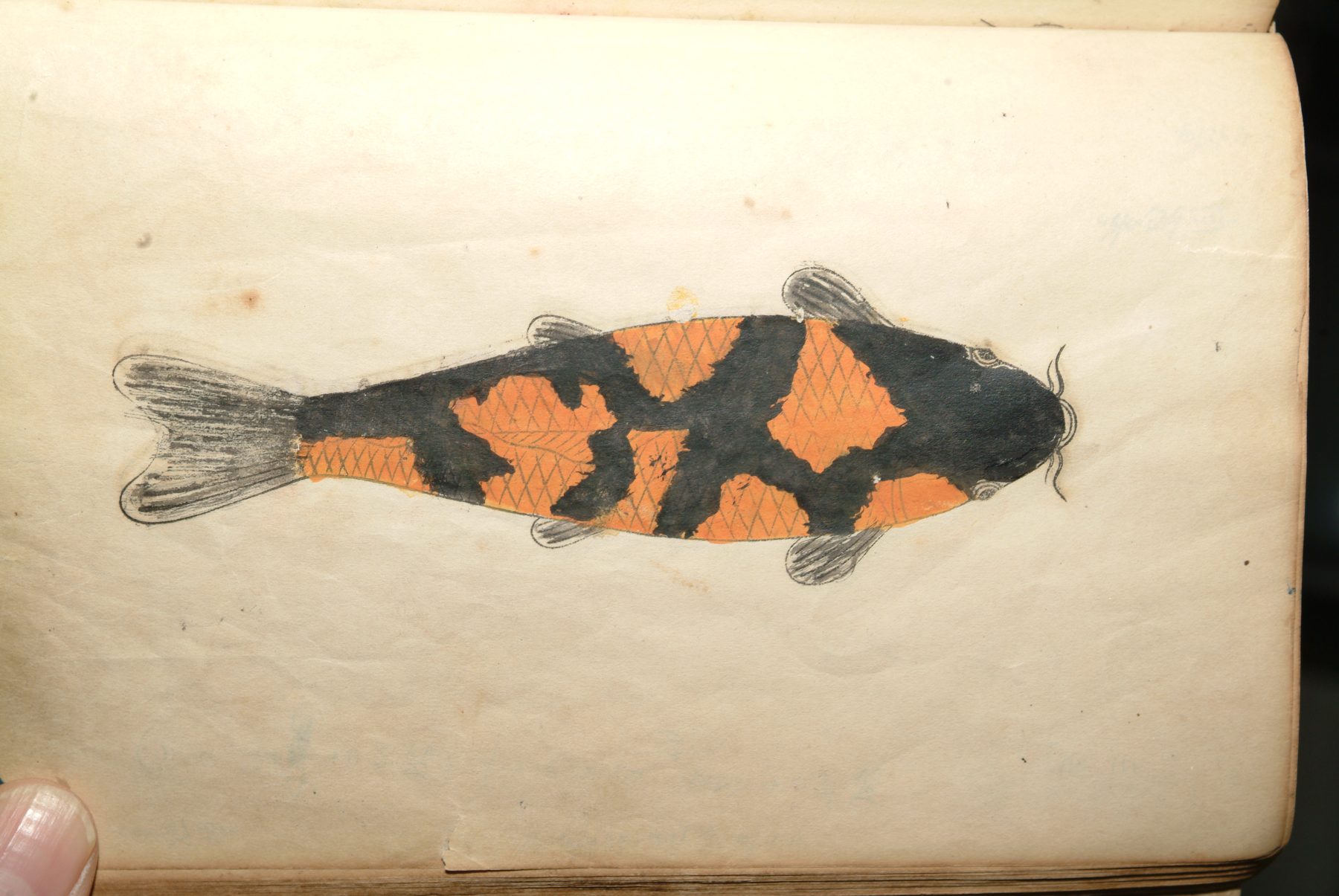
Then Tsuyoshi brought out a book. It is more than a hundred years old and belonged to his grandfather Torakichi. Nobody could take photographs back then, so the only way to keep a memory was a drawing. Torakichi printed the outlines and the scales onto every page with a stamp he had carved himself, then coloured the fish by hand. They show the koi head up, not head down as it is photographed today.
What stands out on the pages is that the fish were slimmer than today. But patterns we know from our own tanks can already be recognised: red-and-white, tricoloured and almost black fish, one of them with a single yellow spot. As he leafed through, Tsuyoshi called that one a real rarity.
yuki雪
Who carries on?
The same question arises in Niigata as it does here in Mecklenburg. There are around a hundred breeders in the region, hobby operations included. Genuine professional farms, members of the Shinkokai, number twenty to twenty-five, and every year there are a few fewer. Small farms cannot invest, and customers want a brand. At Torazo the question has been answered: Tsuyoshi's eldest daughter Yuki and her husband Homare have been working there for seven years and carry the farm forward today. Yuki's name is written with the same character as the snow to which koi breeding in Niigata owes its beginnings.
kettō血統
No bloodline without a second farm
In our conversation I explained to Harry why no farm can stand on its own, not even the big ones. Whoever leads in a variety needs a second farm as a competitor, to exchange parent fish with and bring new traits into their own line. Timing is everything: recognising when the other farm has produced a fish that will move your own line forward – and then being able to buy it. It is always trial and error.
"You always need the influence of a second or third farm."
On the way to Hiroshima.
On the road with Tsuyoshi
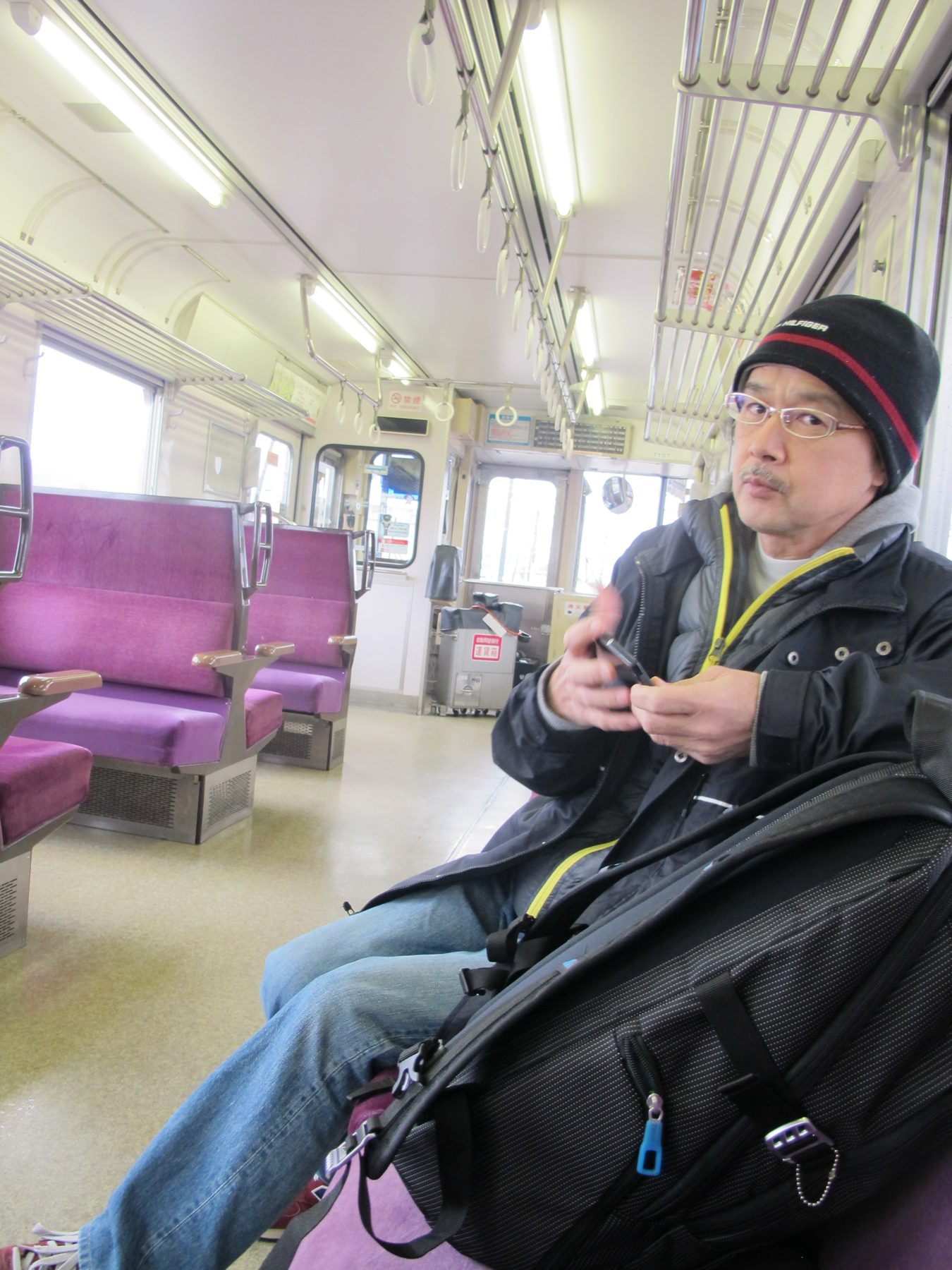
I also travelled through Japan with Tsuyoshi, to Tokyo and to Hiroshima. In Hiroshima we were on a selection trip visiting private hobbyists. They had raised very large fish from famous farms such as Dainichi or Sakai and were happy to pass them on to breeders as parent fish, perhaps to gain access to their offspring later. Tsuyoshi bred from fish from such trips in the years that followed.
How uncomplicated this is in Japan still fascinates me. At the airport you get a ticket for the next flight from a machine, board, land, pick up a rental car and drive to the breeder or hobbyist. If you come to an agreement, the fish goes straight into a shipping box and flies back to Tokyo with you on the same plane that evening. By car it's on to Niigata, and the fish goes into quarantine on your own farm.
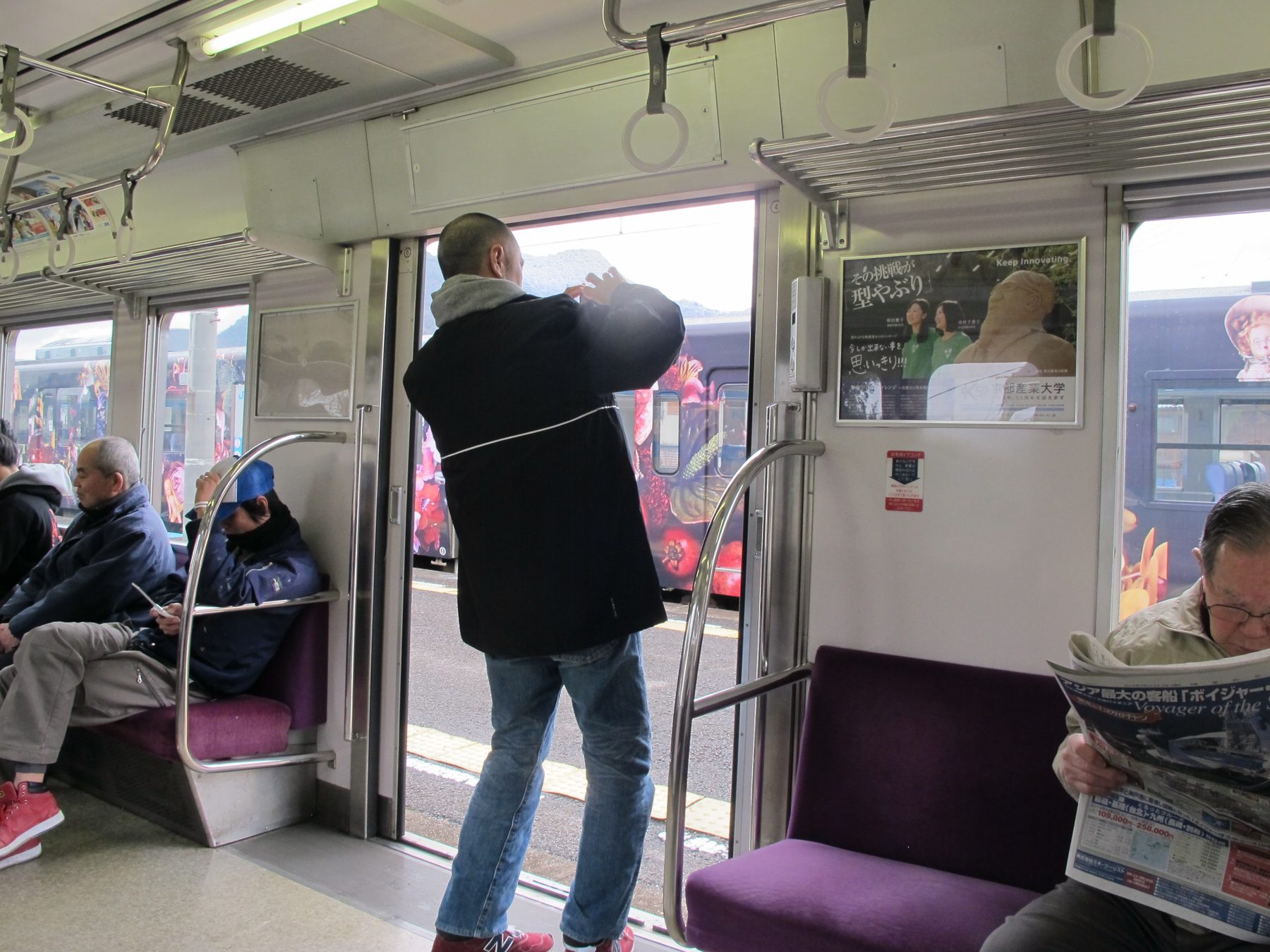
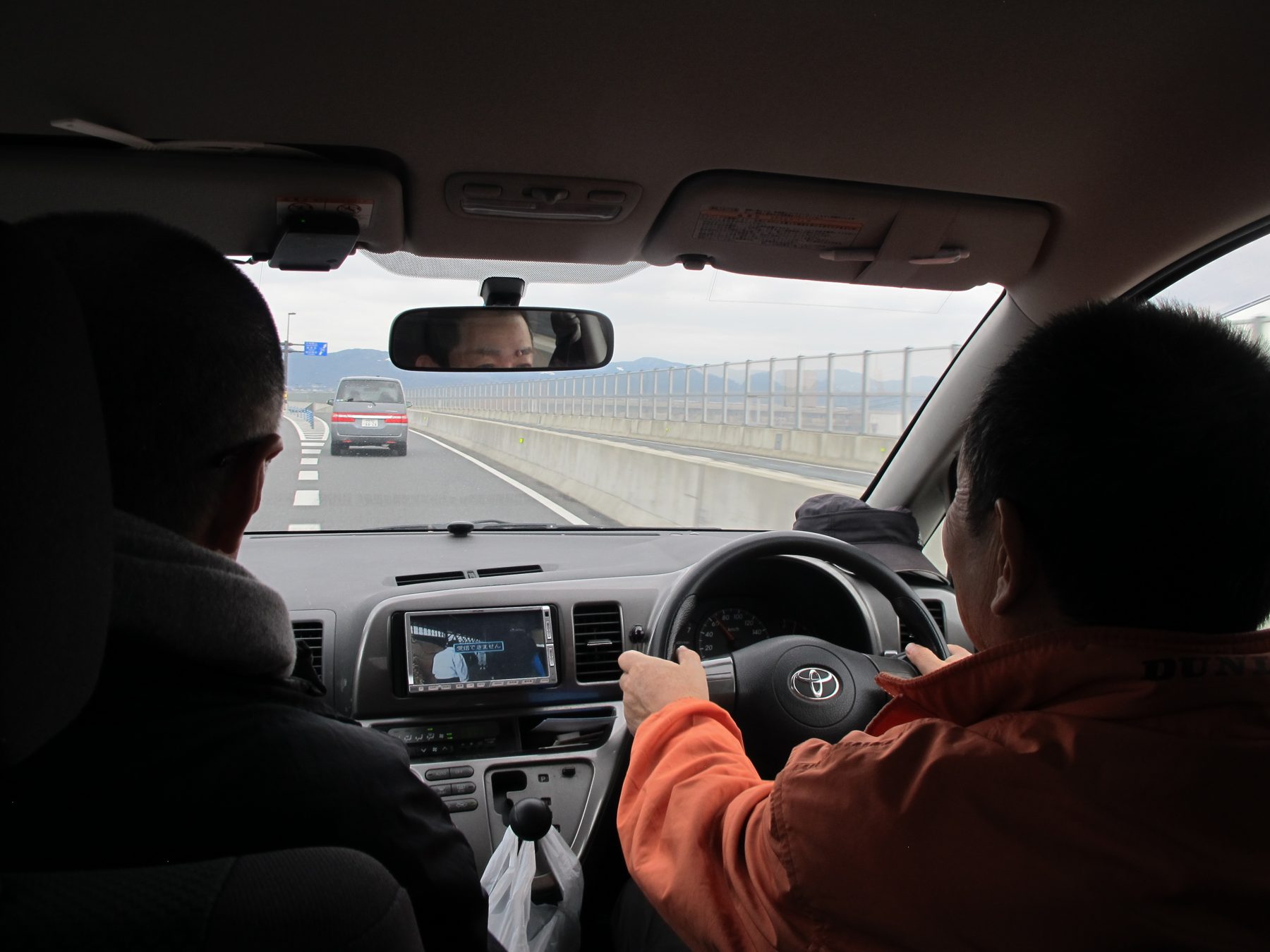
By train from stop to stop.In the car to the next visit.
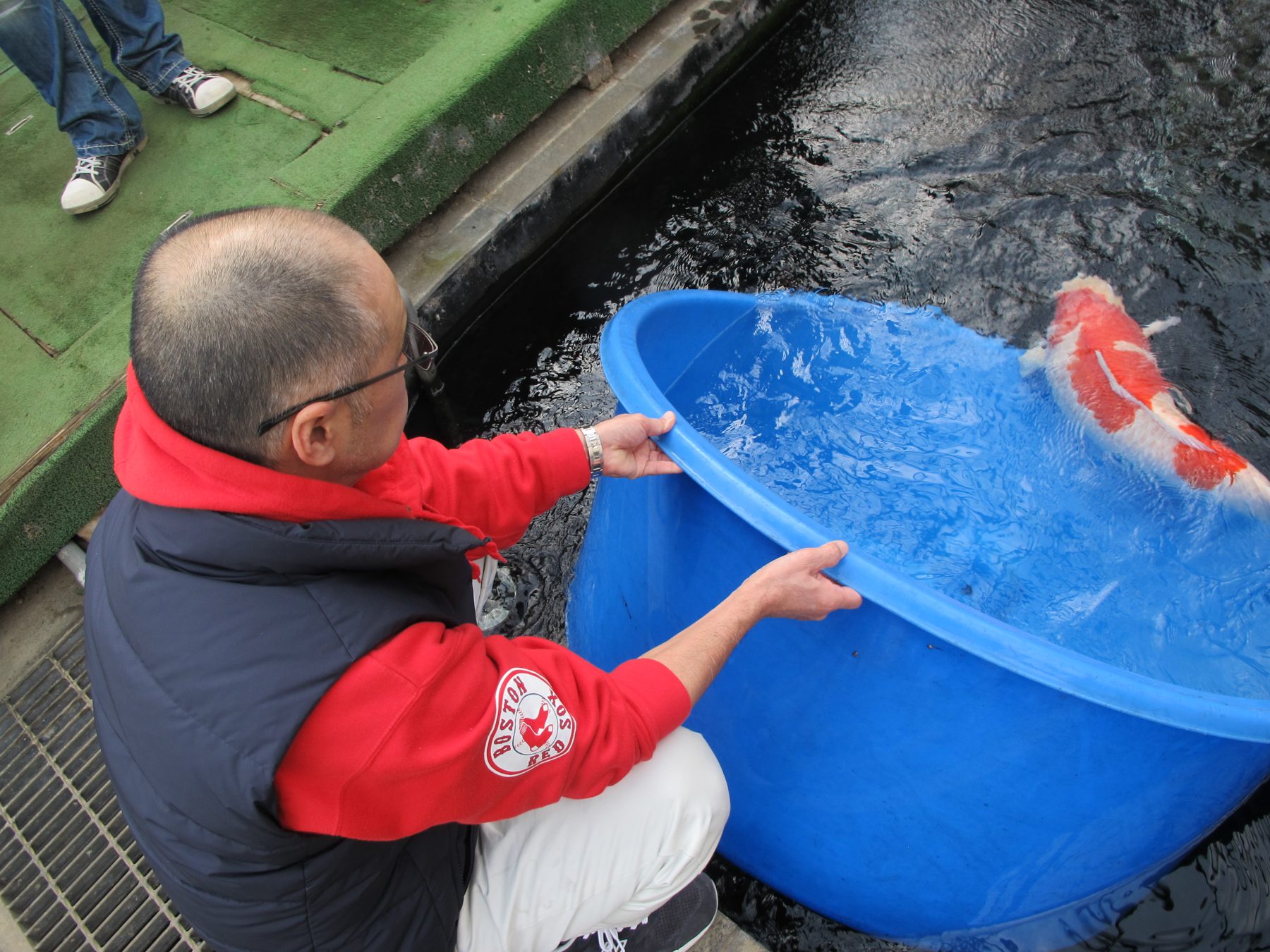
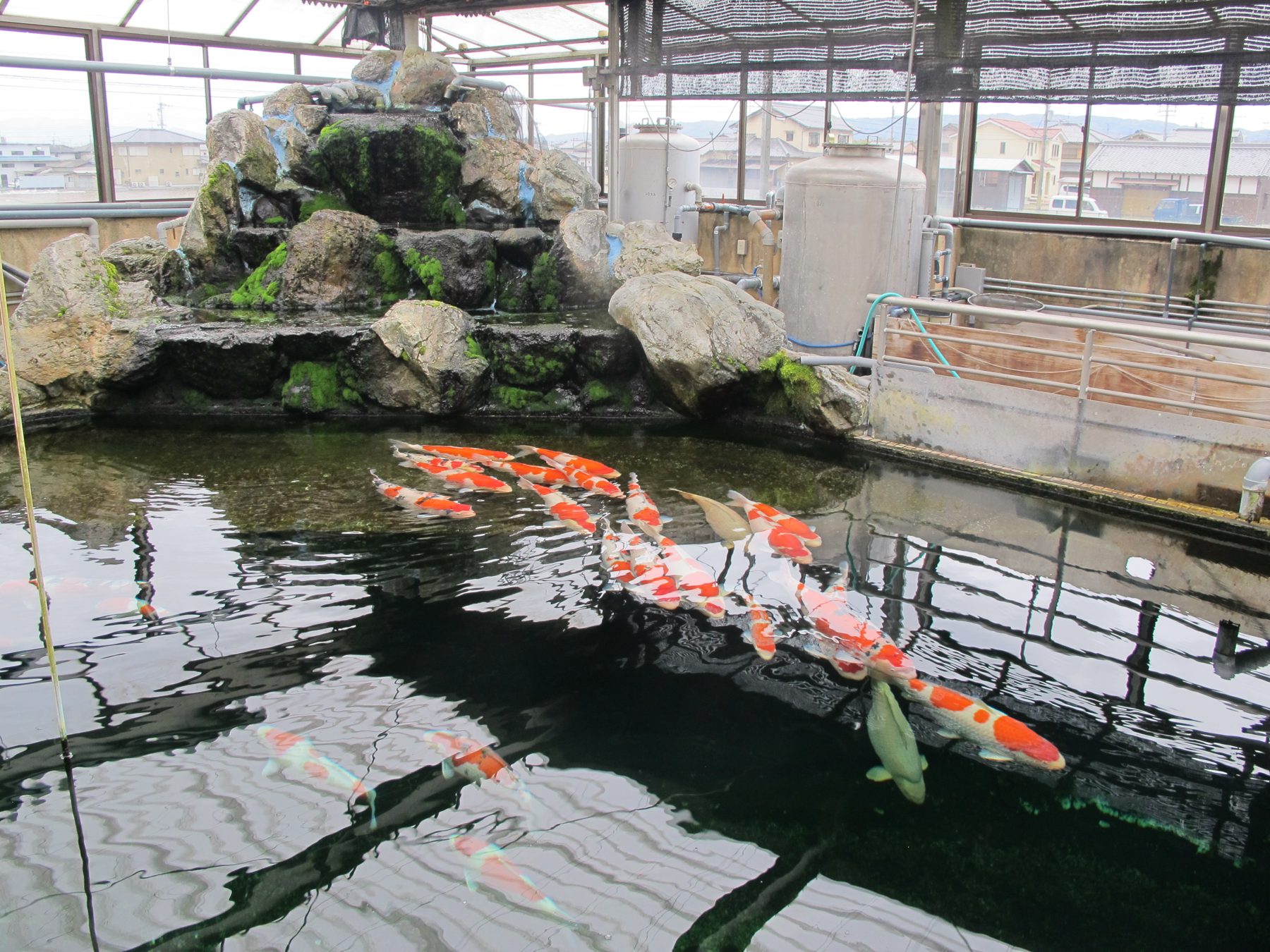
Tsuyoshi Kawakami at the hobbyist's in Hiroshima.Large fish from famous farms, kept as parent fish.
Beyond the horizon
On the same trip Harry and I visited the largest land-based trout farm Japan is currently building. The next article tells that story.
To provide the best experience, we use technologies such as cookies to store and/or access device information. Consenting to these technologies will allow us to process data such as browsing behaviour or unique IDs on this site. Not consenting or withdrawing consent may adversely affect certain features and functions.
Functional
Always active
The technical storage or access is strictly necessary for the legitimate purpose of enabling the use of a specific service explicitly requested by the subscriber or user, or for the sole purpose of carrying out the transmission of a communication over an electronic communications network.
Preferences
The technical storage or access is necessary for the legitimate purpose of storing preferences that are not requested by the subscriber or user.
Statistics
The technical storage or access that is used exclusively for statistical purposes.The technical storage or access that is used exclusively for anonymous statistical purposes. Without a subpoena, voluntary compliance on the part of your Internet Service Provider, or additional records from a third party, information stored or retrieved for this purpose alone cannot usually be used to identify you.
Marketing
The technical storage or access is required to create user profiles to send advertising, or to track the user on a website or across several websites for similar marketing purposes.
 Deutsch
  Nederlands
  English
  Français