
Body before pattern
Sorting with Shigeru, episode 3. About bloodlines, a Grand Champion for 50,000 yen and why the most beautiful pattern rarely wins.
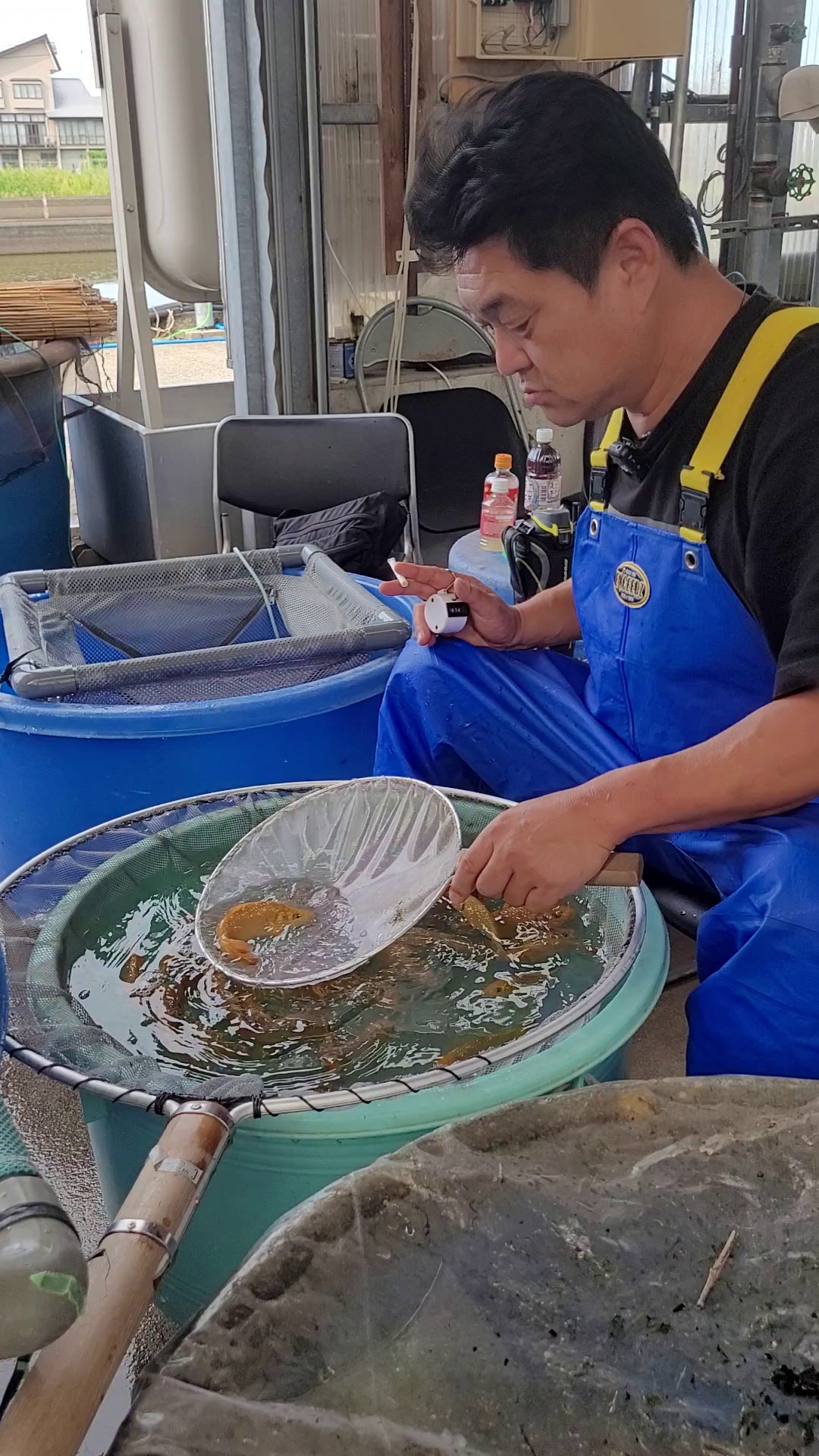
At the mudpond, September 2026. Photo: Naoto.
For two episodes Shigeru talked at the sorting bowl about his Kawari lines. In the third I wanted to talk about something that concerns every hobbyist, whether they like Kawari or Gosanke: how do you recognise a koi that will turn into something? And how much does the bloodline tell you?
What the bloodline reveals
Again and again customers come to me wanting a Showa from the Mona Lisa line or from the White or Black Monroe line. They want to talk about bloodlines. My view on this is clear: for a hobbyist, the bloodline is far less important than they think. What matters is the fish swimming in front of them. What is the body shape like, the head, the motoguro, the colour, the skin? You have to see that in this one fish. I am happy to talk about bloodlines, but with the breeder, when I visit in June and see what he plans to do with his parent fish. Then it is a wonderful conversation about ideas and directions. About the quality of the fish you want to buy, the line says little.
Shigeru agreed with me and still defended the customers. "If I were a hobbyist, I would ask which bloodline is the best too," he said. It's just that reality is more complicated. If he has five lines, the first may produce fifty or sixty percent good fish, the fifth only ten percent. But those ten percent are often better than anything from the first.
Then he told us about a Nisai that Dainichi had sold very cheaply, for 50,000 yen. The fish later became Grand Champion. "Don't ask me why. I'm not God," said Shigeru. "If I knew the future, I would never have sold it."
For a breeder, there is a second side to this. Some lines produce a great many beautiful fish of medium quality that sell well. Others produce only a few, but among them perhaps the future Grand Champion. What a farm lives on is usually the former.
Everyone looks at the pattern
With small fish you see almost nothing but the pattern, Shigeru understands that. The body shape is hard to see, the colour changes constantly. But in his experience, it is precisely the fish with the most beautiful pattern that, in percentage terms, often don't grow strongly. And he sees the same thing again and again: people see the beautiful body and say "wow", and then they spend their money on the other fish, the one with the beautiful pattern and the weak body. "Always wrong, always wrong."
Sometimes, though, I understand why hobbyists in other countries buy differently. In Thailand and parts of Indonesia it is hot all year round. There is no winter rest, no autumn in which the fish eat heavily as the temperature drops, no period between cold and summer in which they build volume. There, the enormous volume of a champion koi is hardly achievable, and so hobbyists pay more attention to skin, kiwa and sashi, and to the pattern staying stable.
"Anyone can recognise a beautiful pattern in a Nisai. But the art is the good body."
A metre-long fish with a big body wins
Shigeru divides his customers into two groups. One looks for the beautiful pattern and hopes for a size award. The other says: I don't need a size champion, I want a Grand Champion, show me which fish to buy. He advises them: look at the body first, then quality and skin. Whether the pattern is large or small is secondary. "I have never seen a Grand Champion with a really beautiful pattern," he said. "Always a decent, average pattern. Over ninety centimetres, good body: Grand Champion."
That is why, when he selects Nisai, he sometimes likes precisely the slightly ugly fish with the really good body. Wait five years, over ninety centimetres, a broad body, and then ten people ask: how did you keep this pattern? "That is art, real art," he said. "A fish like that is a diamond."
My green fish
I told Shigeru a story of my own. Many years ago I was standing in Maruhiro's greenhouse; it was the start of the season and the water was still a little cloudy. A fish appeared at the surface, deep green like a Japanese cedar, with a slight metallic sheen. A fantastic fish. I spent hours at that pond to see it again, because I wasn't sure the picture in my head was real. In the end we netted the pond and found it: a Sansai of about 58 centimetres. I bought it and took it to Germany.
There, it no longer looked the way I remembered it. After a year or two it turned bronze-brown with a metallic sheen, and after two or three years it was over ninety centimetres long. In the end I sold it, but it wasn't a good deal. In that first moment it was something very special.
"That's how it goes with Kawari sometimes," said Shigeru. "You can trust the shape, but not really the colour." How to make the special quality stable, so that a fish keeps it for four years, is the breeder's real work.
was the price of a Nisai that later became Grand Champion.
and a good body: that's what a Grand Champion looks like to Shigeru.
Ginrin is what a Ginrin Showa pairing produces at the first selection. Only a few of them are good.
Black Diamond, a moment in a lifetime
We experienced together an example of how much colour can change: the Black Diamond. When Shigeru bred it, there were many beautiful, shining white fish with a little black. Then the black came up, as you know it from Kumonryu, and at four or five years they looked very special. With age they became blacker and blacker. The truly beautiful Black Diamond is only a moment in its life.
Back then I had bought about four hundred from Shigeru and kept thirty or forty of them, the most beautiful. As Sansai they were wonderful, and in autumn I sold some. In spring the customers wanted to collect their fish, and I couldn't find them again, they had changed so much. I had to call everyone and ask them to come again and choose their Black Diamond anew.
Shigeru has given up on the Black Diamond. "So difficult," he said. The body shape, however, was excellent.
Food and a new Showa line
Kawari don't need expensive colour food. Shigeru gives them the same as the others, just without carotene, and always mixes four or five different kinds.
Things get exciting with the Showa, for which Dainichi is known. Last year Shigeru crossed the Karashi line with Showa, or more precisely: the second generation of the Karashi line, already crossed with Kohaku, a Kohaku with about a quarter Karashi blood. He doesn't want to make a Kawari Showa with it, but a new type of Showa, with broader genetics for a bigger body. The Tosai from it are called White Mona Lisa. What will become of them? "I don't know the future."
Why Ginrin Showa doesn't pay
Finally, I asked about Ginrin Showa. Shigeru's answer was a little arithmetic problem: which is easier to make, a really beautiful Ginrin Showa or a Showa? The Showa. And which is more expensive? The Showa again.
He always crosses Ginrin Showa close to the Showa so that the body grows strongly. At the first selection only twenty percent are then Ginrin, eighty percent Showa, and of the twenty percent only very few are good. The Showa from these ponds are mediocre. He uses ten mudponds for it. If he used the same ponds just for Showa, the success would be many times greater. "As a hobbyist I would make lots of Ginrin Showa," he said. "But this is business."
Still, he doesn't want to give it up entirely. He likes Ginrin Kohaku and Ginrin Showa, and as a dealer you have to be able to show many varieties. So every year there are a few, not many. That is perhaps the most honest answer in these three conversations: for a big breeder, every day brings a decision between passion and business.
Three conversations at the sorting bowl
This brings our little series to an end. If you want to hear Shigeru himself, you'll find all three episodes here in the magazine and on YouTube. And if you want to know what the koi trade looked like before there were oxygen and plastic bags, Tsuyoshi Kawakami will tell you.
 Deutsch
  Nederlands
  English
  Français