Haaki, who are you?
Haaki with Bachmann, episodes 34 and 35. Usually Haaki asks the questions and I answer. This time we turned the tables.
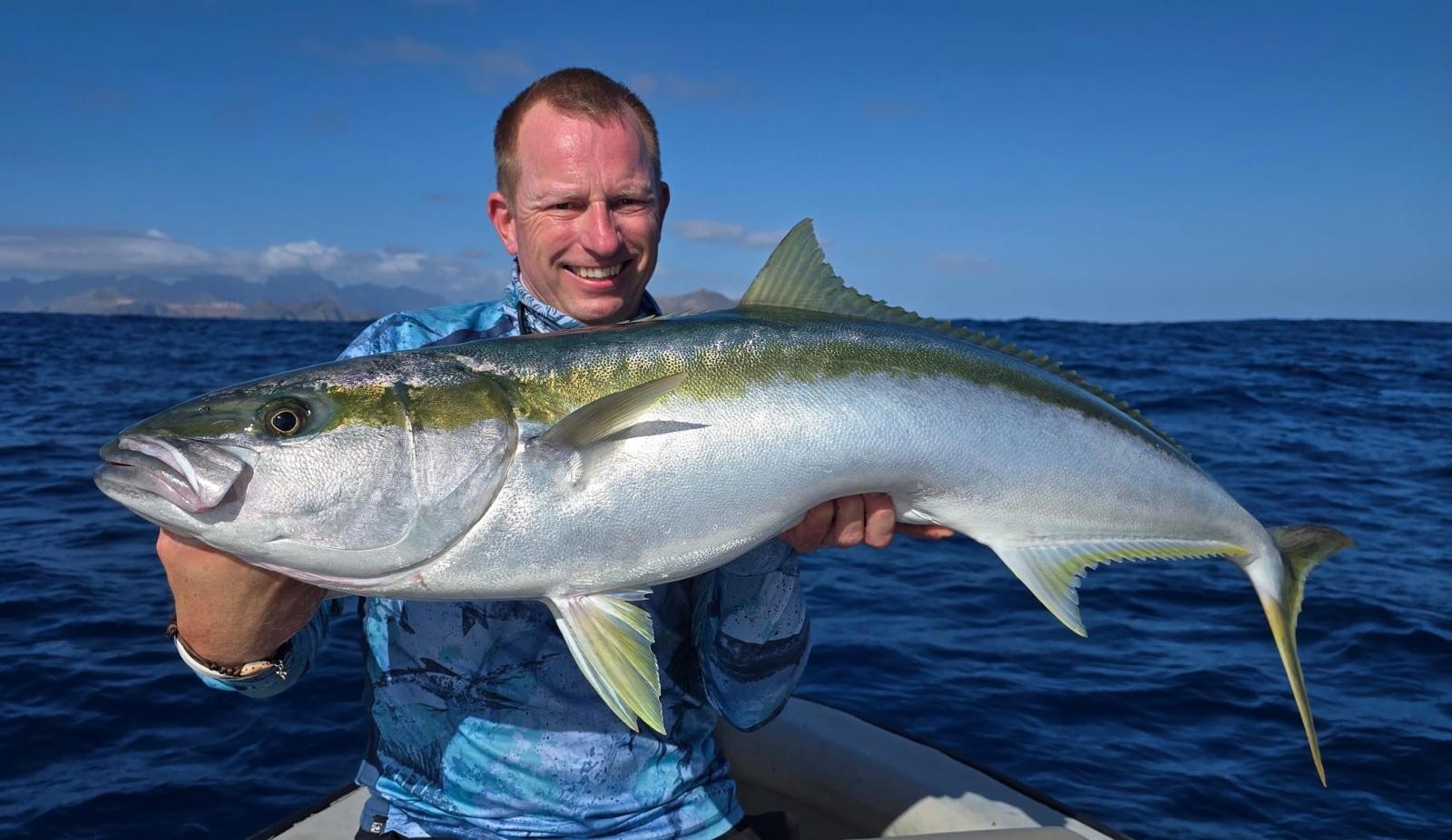
Haaki with a yellowtail kingfish.
In many episodes of our series Haaki sits opposite me and bombards me with questions: about Japan, about breeders, about the koi market. Anyone who listens to him soon notices that he is not just someone asking questions, but is himself deeply immersed in the world of fish. So on 18 October 2026 I asked him for once who he actually is, where he comes from and how he sneaked into our films. The result is two episodes. The first tells how an angler became a koi lover.
A Chagoi and a cold shower
We met in 2018, shortly after I had moved the facility to Mecklenburg. Week after week Haaki had been bidding on our platform, above all on the lighter Chagoi with the fully coloured fins, which were very much in demand at the time. For what he wanted to spend, that was not easy at all. At some point he won a fish, came to collect it and brought a whole sackful of questions with him.
His pond at the time was half a natural pond: pebbles, water lilies, plants, a good 170 cubic metres, with no insulation and no heat pump. I answered him the way I always do. Do you want a koi pond or a plant pond? You have to decide. Where there are plants and gravel, zones without oxygen develop. Haaki remembers this first visit as a slap in the face, and he did not hold it against me. When you talk to an expert, he says, you are glad at first just to get a sound answer. It does not necessarily have to be friendly.
“I think that was more or less our first meeting, when I thought: oh, he's a bit cool, that man.”
From customer to friend
The facility was still being built at the time. The bridge did not exist yet, the corner ponds were not their current size and the new hall had not been built. Haaki was impressed, bought one, two, three more fish and kept coming back. Because he saw how the fish developed in his pond, at some point he stopped buying koi anywhere else.
What turned it into a friendship, though, was something else. On koi questions Haaki always seemed a little unsure of himself at first, and I can't stand that. When we got onto electricity, batteries and the solar installation, and Frank said I absolutely had to ask Haaki, he was transformed: quick, eloquent, full of ideas. I thought, there's more to this man. Haaki sees it more soberly. In the koi world he preferred to hear something from me rather than tell me something. By then he had long since read my books.
Since then we have helped each other. He has advised me on many an energy decision for our facility, and I have advised him on koi. And more than once he has stepped in when I had no time and customers of mine wanted to go fishing.
A life by the water
Haaki first went fishing at the age of four or five, and the fever never let go of him. As a little boy he sat by the waters near his home, and at nine or ten he annexed his father's small 100-litre aquarium. Much the same, he says, as with many of our customers: they come as aquarists or anglers, one day see a well-kept koi pond and think, what fish.
For him one of those moments came in 2001 at Singapore airport, which has koi ponds. He still remembers standing in front of them in amazement. But it took until 2013 before he could build a pond on his own land.
Carp, pike and the shared experience
In the early nineties Haaki began fishing specifically for carp, using boilies at a time when you could not yet buy them ready-made. He rolled them himself, by the hundredweight, froze them, salted them and tried out all sorts of things. Perhaps, he says laughing today, he should have sold his mix by the bag twenty years ago. For a good fifteen to twenty years he fished almost only in Mecklenburg, on the big natural lakes around Schwerin, which are ideal for big carp and anything but easy for the angler. Fish of ten to fifteen kilos were normal, twenty kilos the exception, and he found those too.
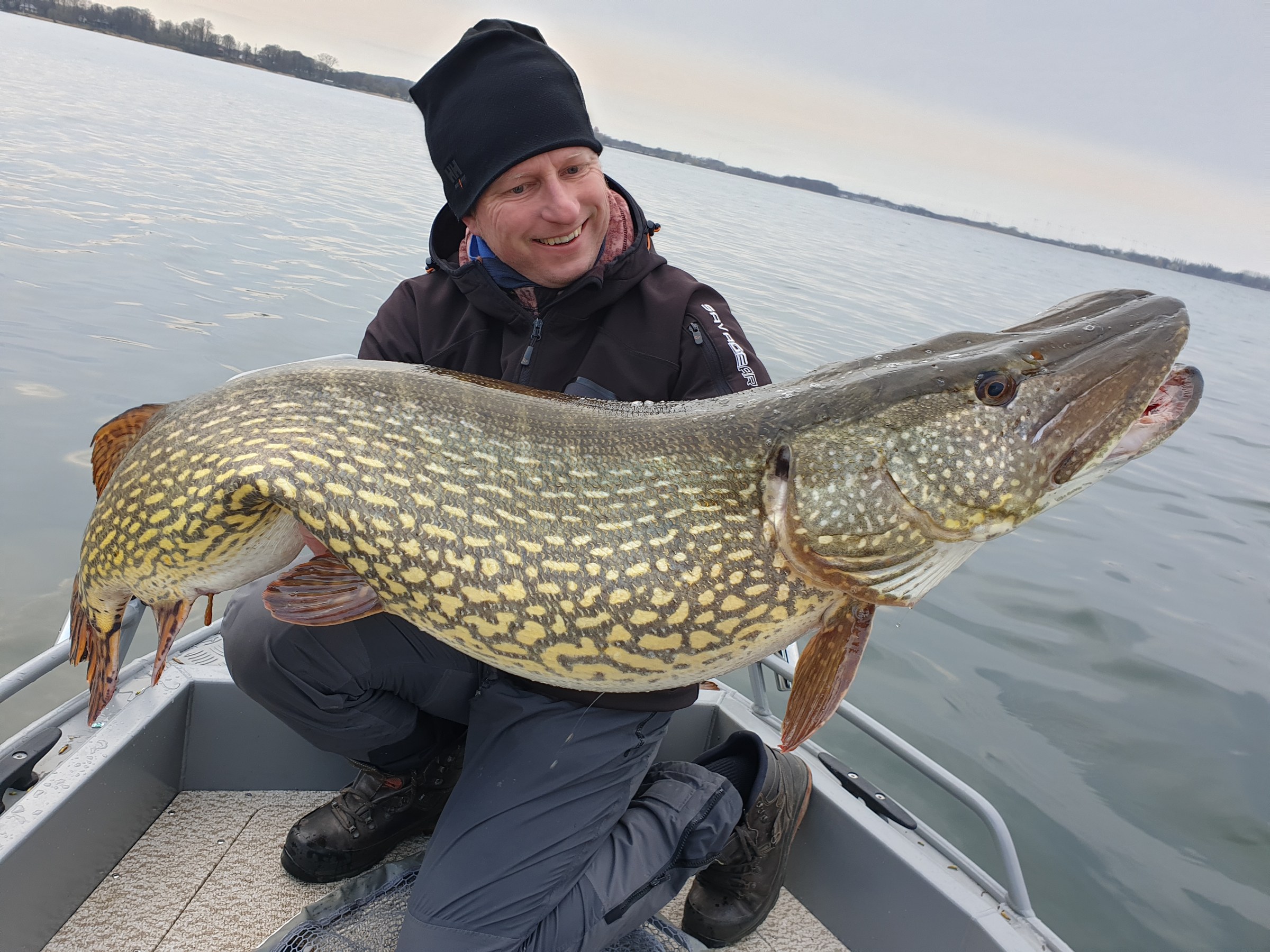
At some point pike were added, above all on Lake Schwerin, with fish of up to 1.24 metres. From around 2010 he fished his way through the species: wels catfish on the Po, salmon, cod and sea trout in the Baltic. And over the years something shifted. At first it was the hunt for the big fish. Later it was the experience, sharing the joy with someone you like being out on the water with.
That is how it was for the two of us on the Plauer See. When trolling, one of you has to keep an eye on the drop-off and steer the boat, the other takes care of the lines. That is almost more fishing than angling, teamwork, and at this level you can hardly manage it alone. The 1.20-metre pike you can see on our homepage was one such joint catch.
In the tropics
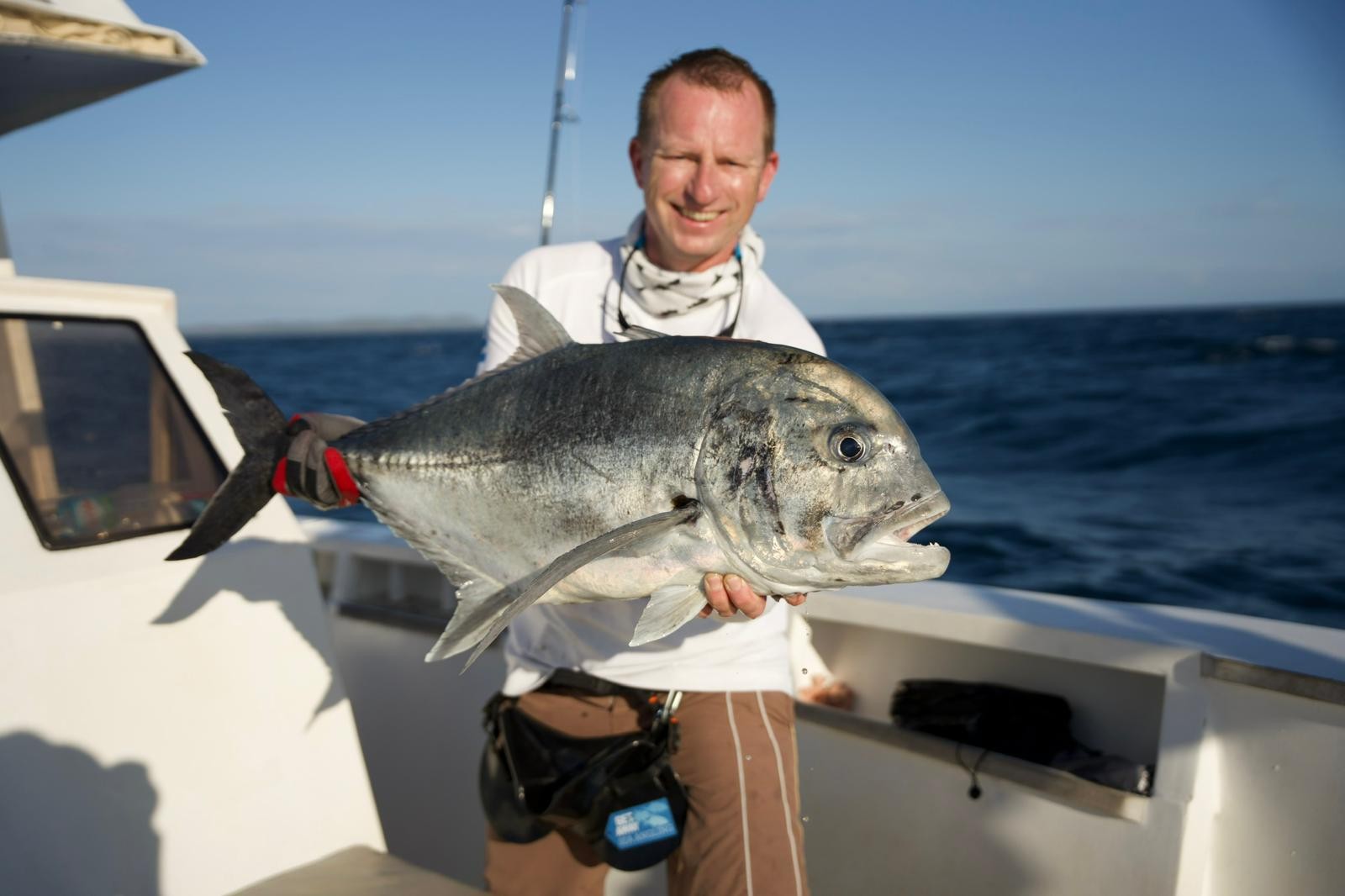
In 2019 Haaki fished in the tropics for the first time, in the Andaman Islands, a widely scattered archipelago belonging to India. There he caught giant trevally, barracuda and other predators at the surface, with a power you never feel in our cold-water fish. It got hold of him. Since then he has made one or two trips a year: Madagascar twice, Costa Rica twice, bluefin tuna off Spain in his own boat.
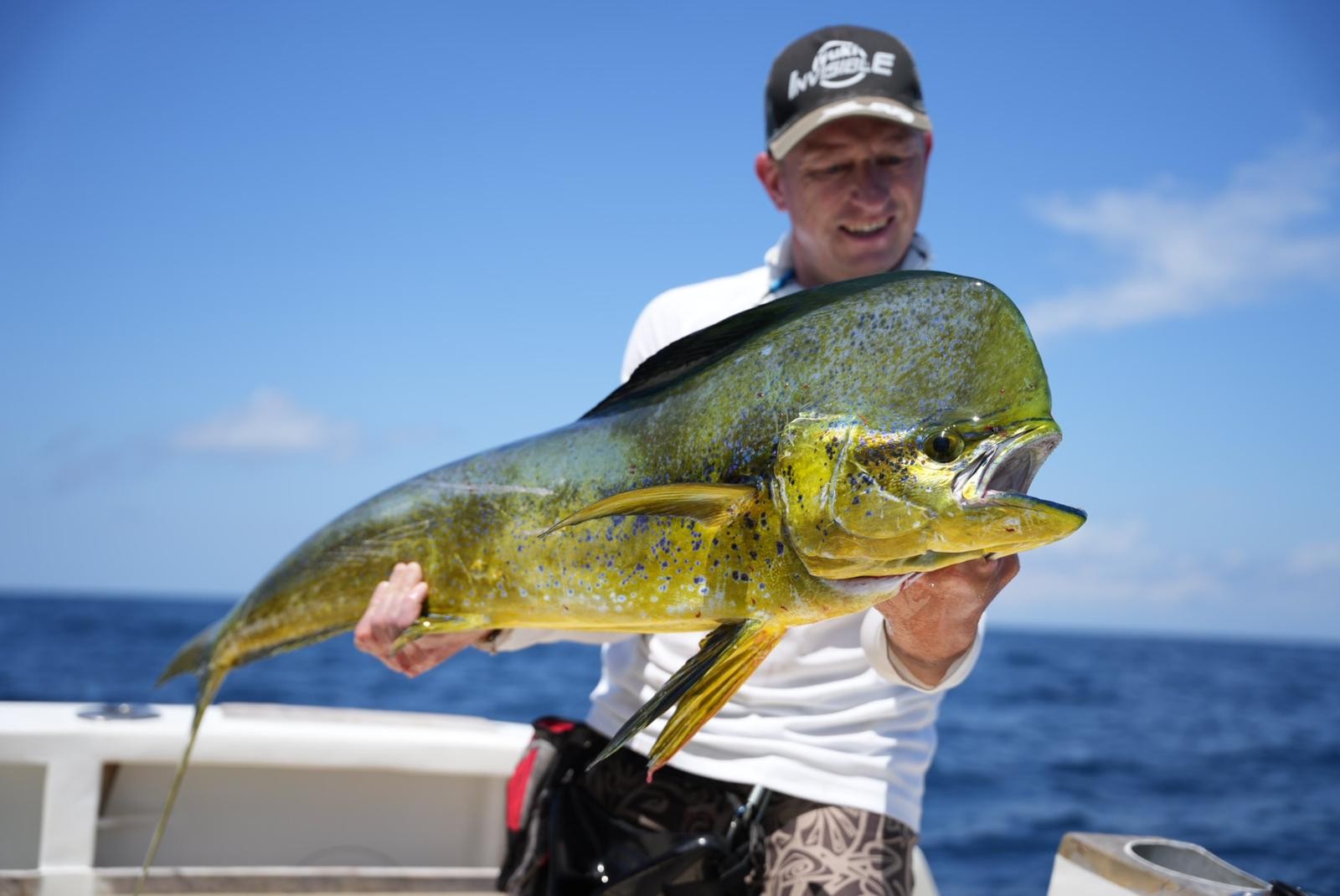
The most impressive for him was Robinson Crusoe Island in the Juan Fernández archipelago, far out in the Pacific off Chile. Wild yellowtail kingfish pass by there, the same species that Bram farms on land in Zeeland. Haaki caught two fish of around twenty kilos. I sent Bram pictures of Haaki with his big kingfish at the time. Bram said Haaki was welcome to bring them along, they would surely make good breeding stock for crossing in a new line. So Haaki, Bram and I are connected through this fish too. And then there are the companions no package tourist gets to see so easily: schools of dolphins hunting together with the tuna, and whales, just in passing.
The second episode is about his own pond, about what he has seen at our facility, and about a night in the fish house in Japan.
A pond, really too big
What fascinated him about koi from the start was their size. As a child you saw goldfish of five to twenty centimetres in ponds, and suddenly there is a fish of sixty centimetres, still a small koi for us, and you think, what a big fish. Then the colours, red, white, yellow, and the question of how so many colour varieties can come from one fish. If he ever had a house of his own, it would not be a goldfish pond, but koi.
He then deliberately built the pond large, about twenty metres long and eight to ten metres wide. He underestimated the work involved. Without insulation, 170 cubic metres can hardly be heated, and with two bottom drains and one skimmer the hydraulics were far too weak once the fish grew. So he rebuilt: new filter chambers with large brush filters, side outlets, until he could circulate about a hundred cubic metres an hour.
And then the plants came out, the rushes, the irises, the water lilies, tonnes of pebbles. Underneath he found what I had predicted: stinking black sludge from dead floating algae. Nice for water lilies, not good for koi. He had no major disease outbreaks before, but afterwards the fish looked visibly better.
Seeing with koi eyes
At first, Haaki says, he looked at koi like an angler: a nice fat belly, good and heavy. In the first year he was hardly aware of what makes a good koi. That changed thoroughly through the books and the many videos. Today he finds it most exciting to spot the good ones among young fish and to see how they develop, for example when the black on a Showa comes up bit by bit. If he were to start over, he says, he would probably build a pure Gosanke pond, only Kohaku, Sanke and Showa.
Discus and altum
Haaki never gave up the aquarium hobby. After the community tank of his childhood came cichlids; in his early to mid twenties he got hooked on discus and raised his own offspring, solid turquoise and red turquoise, not for sale but out of passion. Later he switched to the altum angelfish, which he kept for years in a 1,200-litre tank. In that, too, we are alike.
A weekend guest at the facility
Over the past two years Haaki has often helped me when we select and film fish. He brings the fish over, fills the tanks for photographing and takes the fish to the shipping unit, so that I can concentrate on the good picture and the good video. He has even stood in my aquarium in his swimming trunks setting large stones. He says he is just a weekend guest who comes for half a day now and then. But he sees the fish with different eyes while doing it. When you prepare a hundred Tosai one by one for photo and video, you approach it more soberly, and yet every time he notices something he asks me about.
Half genetics, half environment
What impresses him most is the difference between his pond and our tanks, with the same fish as starting material. Warmth, water treatment, drum filters that allow continuous feeding, and a pH we keep in the neutral to slightly acidic range, while his large pond always sits at around eight. You can see it in the skin: in a pure white and a glowing red.
Many koi keepers underestimate this. They buy a good fish and wonder why it does not look like the photo in their pond. I tell them: at least fifty-fifty. Fifty per cent is genetics, you need a good fish to build up a good fish. The other fifty per cent is the environment you give it, food, temperature, water. The better that environment, the more fish from one year class develop into really good ones.
2,600 fish and honest videos
Anyone who has followed us this year has seen more than 2,600 fish, each with its own video and all the details. Haaki appreciates that I stay honest and do not use the word Tategoi inflationarily. 2,600 fish cannot all be Tategoi. In moving pictures you see a fish differently from a well-made photo, and anyone who listens to me for a while can also hear whether I am enthusiastic about a fish or not.
Of course you can also choose on site with us. But then it is a good idea to look on the homepage beforehand at which fish are candidates and which tank they are in. Anyone who stands in front of three thousand fish with no idea, six hundred Kohaku alone, ends up no longer knowing what he wants. So I tell some customers: stay two or three days. Come on the first day, have a coffee, look around. On the second you look again, and on the third we make a decision.
At night in the fish house
Back then Haaki also read my Japan reports from 2018 and 2019, and the spawning season fascinated him in particular. We park in front of the greenhouses and sleep in the cars, with one ear on the fish house. When does it splash, when does it thrash? At three or four in the morning you go in and see what the parent fish are up to. At dawn new fish are moved and weighed, and everyone wears a head torch. That, says Haaki, has something of carp fishing about it.
You also see how clean these fish houses are; you could eat off the floor. Whether a breeder spawns artificially or lets the fish spawn naturally, in my experience it is the hygiene behind it that separates the top breeder from the ordinary one. The same goes outside at harvest time. In Dainichi's natural ponds you find hardly any sludge, hardly any leaves, only thin moss on the bank, the slopes tended, the branches cut back. Elsewhere you sink into the mud at harvest.
That leaves the question Haaki asked at the end. A mudpond literally means a pond of mud, and he had always imagined a mineral-rich clay and loam mud. What is meant, though, is an earth pond. The earth, the basin the pond is made of, is rich in minerals. The rotting sludge from leaves and dead plants, on the other hand, consumes oxygen, raises the pathogen load and lowers what a pond can produce. That is why at Dainichi it is removed with an excavator before a pond is filled again in spring.
More with Haaki
In the conversation before that, Haaki was asking me again: about Japan, China and a cola machine that gambles for your can.
 Deutsch
 Nederlands
 English
 Français
 Italiano