When tosai become nisai
Haaki with Bachmann, episode 33. Back from Japan and into our own facility: Haaki asks about the season, jumbo tosai, filters, feed and the light in the north.
Our koi house in Mecklenburg, September 2022.
On the same day as episode 32, 30 August 2026, Haaki and I stayed sitting in the koi house. After Japan, this time it was about our own facility. The season is drawing to a close, the fish will soon have their birthday, and the tosai become nisai. How satisfied am I with this year's rearing? That question came first, and it turned into a long tour of everything that makes up a season.
More technology, more fish
This year we installed more technology and kept more fish at the same time, and the two cancel each other out almost exactly. With the same stocking as before and the new technology, the result would probably have been even more impressive. But a koi business also has to fit the market. In the end it is always about the balance between what is in a fish and what a hobbyist can buy it for.
How big does a jumbo tosai get?
With jumbo tosai you can quickly see how a season has gone. Can I get them to fifty, to fifty-five or beyond? With fewer fish per tank we could have made them even bigger. Shigeru in Japan sets the benchmark: in mid-May he puts fish of 51, 52, 53 centimetres into the mudponds. But at his place only twenty-five jumbo tosai swim in sixty cubic metres. With us it is three hundred.
It is also important that a jumbo tosai really is one. Anyone who buys a so-called jumbo tosai that is in fact a held-back nisai often sees rapid growth and feels vindicated. In reality the fish is only catching up on what it missed before. Experts call this compensatory growth.
We came very close to Shigeru's benchmark in the first year after moving here, and two years ago with a particularly strong year of sanke, when in January we had sanke nisai of seventy centimetres. Now, as the days get shorter and the water slowly cooler, the growth curve really starts. Two days before our conversation I had switched the wood-chip heating back on, for one last warm spell before October.
“What you don't get into the fish now, you won't get onto its ribs.”
Why a jumbo tosai is called nisai in October
Many people don't understand why we call a fish jumbo tosai until the end of September and nisai from October. That is how it is done in Japan. At the end of September it is a magnificent jumbo tosai of 55 centimetres, a week later a nisai of 55 centimetres, and suddenly it seems small. Yet all it has done is hop over a date line.
Strictly speaking, in Japanese every fish of the new year class counts as tosai, and as soon as the next tosai hatch in June, the old one would actually already be nisai. But it was never traded during that time. Over the summer it stays in the mudpond, and in the warm summer hardly anyone ships koi to Europe. Only with the autumn harvest does the koi world meet again in Niigata, and only then is it called nisai in the trade. That is how it has become customary among the breeders in Niigata and in the international trade. Anyone who speaks Japanese but stands outside this koi world easily stumbles over it. Incidentally, German carp farming counts by summers in a similar way: a K2 is a two-summer carp.
Shinoda, Kano and the goshiki puzzle
I must thank Shinoda when I am back in Japan. He sent us really beautiful tosai. But you can never say one hundred per cent whether it is down to the selection or to the rearing. When Kano sent us the first goshiki, they grew just as well as our Dainichi fish. As nisai we had goshiki of 56 and 58 centimetres; I had never seen anything like it, even in Japan.
The following year I couldn't do it again, nor the year after. Today's are around 44, 45 centimetres, still respectable for goshiki. What it came down to, I can't say. There are so many adjusting screws: oxygen, circulation, pathogen load, parasites, the feed, the selection. We are too small for our own laboratory that analyses every batch of feed. Bram in Zeeland, who feeds tonnes every day, has every delivery tested before it is blown into the silo. He knows exactly what he is feeding. We have to guess a little.
On the other hand, how long the fish wait for their flight after selection in Japan hardly matters. Last winter a shipment was almost on the lorry when a snowstorm warning came, the motorway was closed and the fish had to wait an extra week. That is a nuisance, but it can be made up with high temperatures and targeted feeding.
The big ones in tank 15
There is now plenty of room in our tank with the big fish. I haven't added any, only sold, and the fish simply grow well. Now a new generation is reaching size. The big shiro still belongs to the old guard; it saw Pfungstadt. The showa swimming past right now came here as one of the first jumbo tosai. The goshiki are heading towards eighty centimetres; they won't get much bigger, but thanks to the jumbo tosai rearing they have astonishing width and power. Some of our fish have passed one metre at customers' ponds.
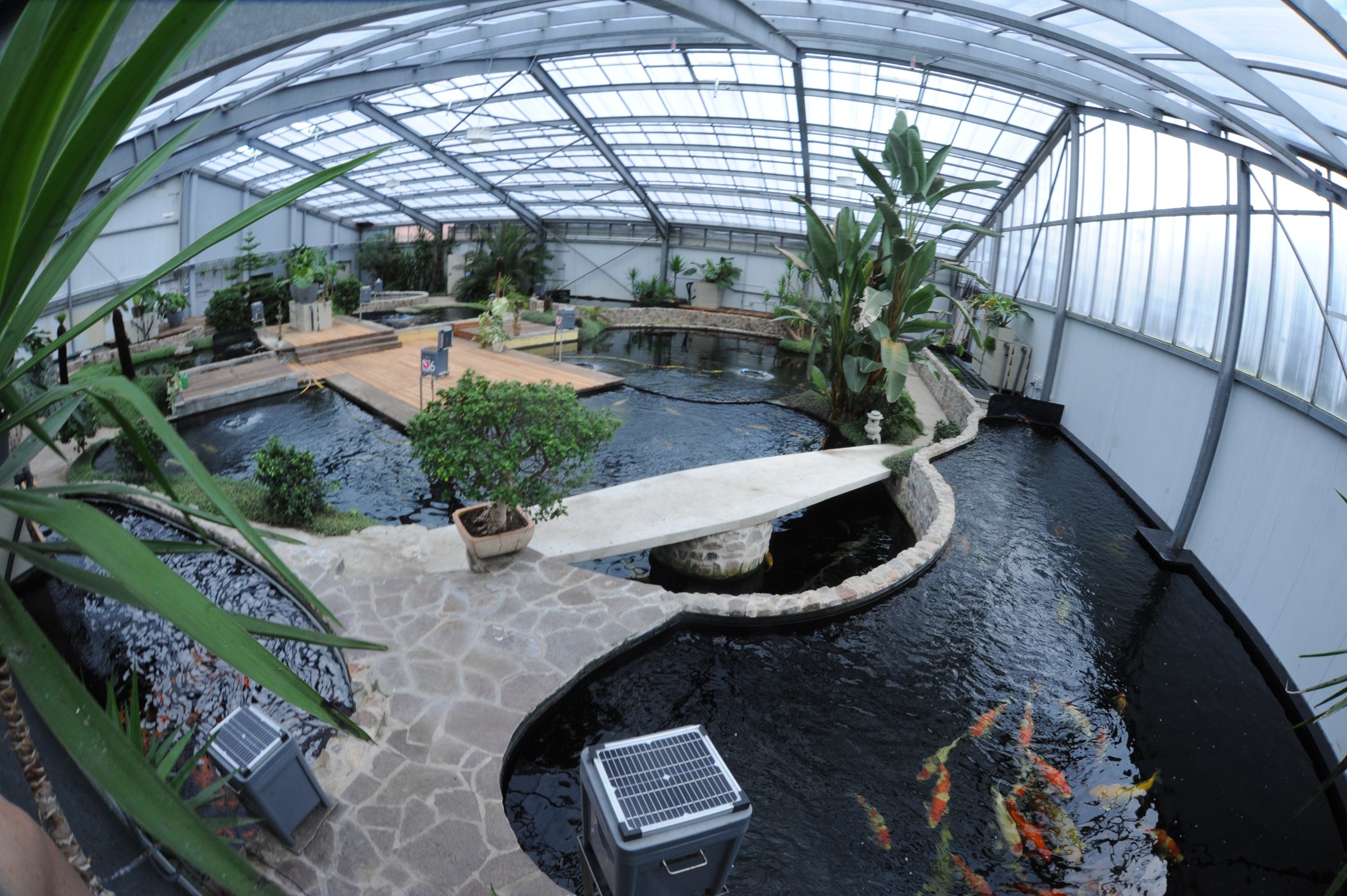
It has always bothered me that people collecting fish usually only look through the entrance door and see the small fish there. Hardly anyone dares go to the back to the big ones. That is why this winter a second tank with big fish will be added, at the front, where everyone can see them.
In winter we keep the big fish's tank a little cooler than the tosai tanks. If big fish swam at 24 degrees all winter, you would ruin their potential. Heart and metabolism also need to rest at some point.
Straight to the front door
In spring a dedicated haulier drives for us. It loads the fish here and takes them straight to the customers, without transfer at a distribution centre, without reloading into an articulated lorry and then into a van. For live fish that is much gentler. And the more sansai we offer alongside nisai and jumbo tosai, the fuller and more frequent these trips can be.
Japanese mats crosswise
Right in the middle of the question about filter maintenance, the automatic feeders started up, and in the big tank that is a spectacle every time. The splashes reach the edge of the filter, but no further. Right now we are turning the feeders up and up: the fish notice the days getting shorter, and now they are building volume for the winter.
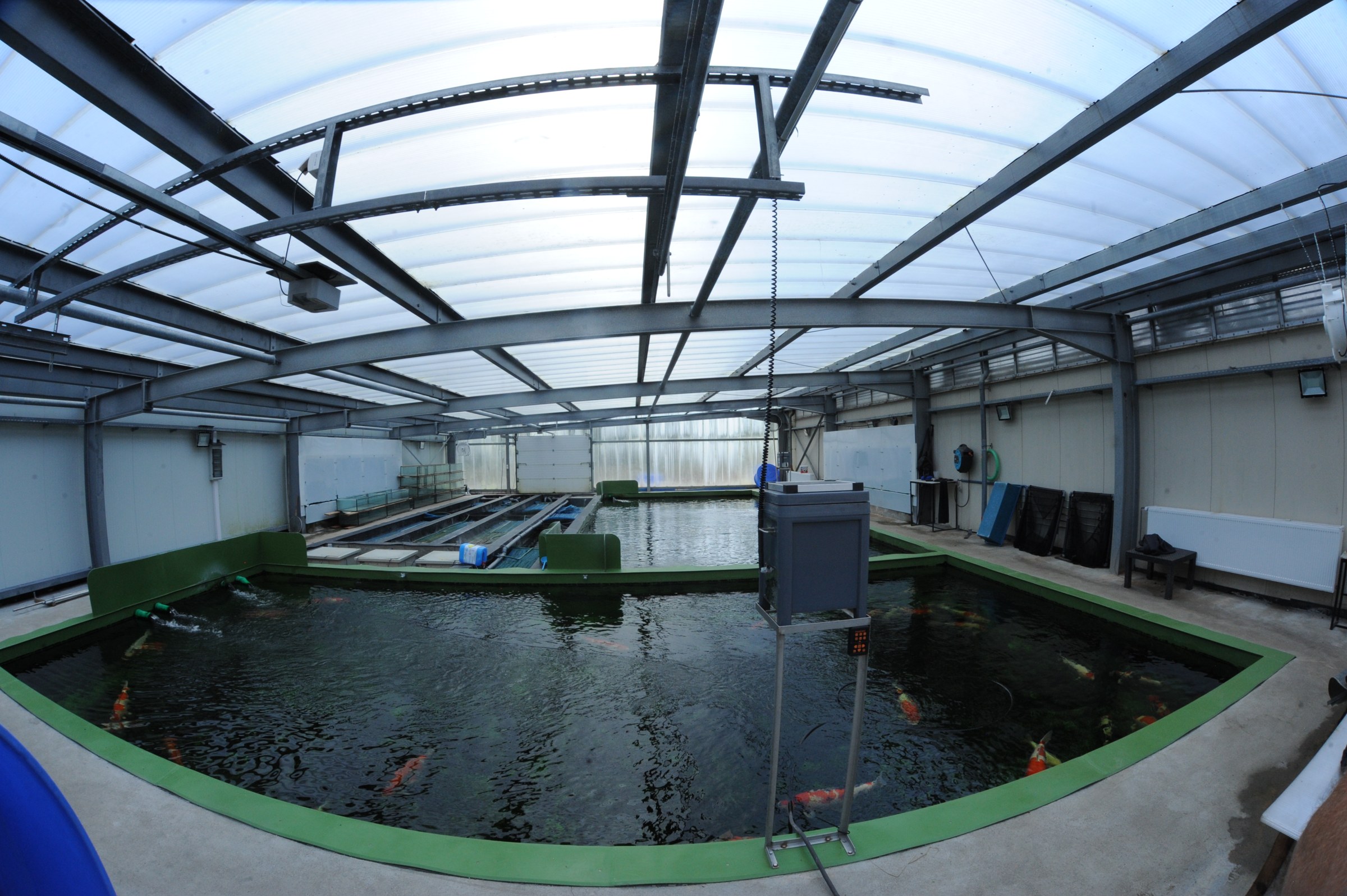
With the filters I have gone back to my old conviction. When we came to Mecklenburg, the Japanese mats stood lengthwise in the flow between Plexiglas panels. That didn't work. The mat has to stand on the bottom, stick out above the water surface, and the water has to be pushed right through it. That is how I did it in Pfungstadt, and that is how I have rebuilt many tanks. The first mat holds back the coarsest dirt. When the water level drops at the back in the last chamber, we know the first mats at the front need cleaning. Then there is nitrate removal: where no nitrate arrives in the filter any more, no unwanted germs can build up in low-oxygen corners either. That has proved its worth.
The J-curve
With so many fish, artificial intelligence now takes a lot of work off our hands. But it too has to be fed first. In a business programme I found the image of the J-curve for this: anyone introducing a new technology first slides downwards because learning it takes time, and only when everything is running does the curve go up. On the way, plenty still goes wrong, and each time you learn something.
New feed and the light in the north
Finally Haaki asked about feed. I am in talks with two or three manufacturers who could make something new, so far only on screen. They are at the other end of Germany, and I want to meet them in person. I have already tested the direction here, on a small scale, with a mixer, oils and a spray gun for the coating. This year we sent our health feed out with many customers, and it went down almost too well: in the end I was standing there with a drilled-out spray gun just to keep up. For so many customers you need a manufacturer, and we will test their feed against ours here.
It is less about growth than about health and colour. I believe that here in the north we have to make up for something special. At the winter solstice our day is about forty minutes shorter than in Frankfurt am Main, and in my experience you notice that in the tosai. The extra light in summer doesn't help. That is why in winter I feed various algae as a supplement until the UV light returns in spring. That is the particular game of a facility at this latitude.
More with Haaki
The first conversation that day was about Japan and the koi market. And who Haaki actually is, he told me himself later.
 Deutsch
 Nederlands
 English
 Français
 Italiano
 Español
 Português
 Română
 Polski