
Spawning season at Dainichi
Haaki with Bachmann, episode 38. How to recognise a top breeder: by the hall, by the pond and by the June nights when the fish spawn.
Spawning night at Dainichi, June 2018: checking with a head torch whether the eggs are ready.
After the two episodes about my trip in September, Haaki wanted to know something fundamental. Today the internet is full of countless photos and videos from Japan. Can you already tell from them whether you are at a top breeder or an average one?
You can. And you see it most clearly in June, during spawning season. Normally there are no European buyers about then, in fact no foreign buyers at all. Anyone standing at a breeder's in these weeks is pretty much alone as a foreigner. Spawning takes place in the very early hours of the morning, and everything it requires is prepared during the day. That is exactly where you see who has mastered the craft.
Order shows
It starts with the fish house. There are breeders where you walk into a greenhouse with equipment standing around everywhere, perhaps a flower tub spending the winter there too. You notice at once: this is more of a hobby attached to the house. At Dainichi a hall is sometimes converted when an auction takes place there, with seating, a large monitor and the auctioneer's desk. But afterwards everything is cleared away again, and what remains is a clinically clean greenhouse: filtration, room to walk, room to take photos, and nothing in the way.
You can recognise top breeders by their greenhouses being fairly new, clean and tidy, and by their trying out new technology, trickle filters for example, or by now drum filters too.
The same goes outside at the natural ponds. How much mud lies in the pond, and how often is it dug out with excavator and crawler? Is the bank neatly mown, or do moss, branches and clumps of turf hang into the water, are there water lilies or reeds growing? All of this forms surface on which fine algae settle, and pathogens with them. Mud consumes oxygen and creates oxygen-free zones in which bacteria such as Pseudomonas thrive, which can make a fish ill when it is weakened. The immune system has to work against this constantly. And whatever costs the fish energy is energy it cannot put into growth.
“You can always recognise top breeders by their greenhouses being fairly new, being clean, being tidy.”
Video not showing? Watch on YouTube · Subscribe to the channel
The night belongs to spawning
When the parent fish are put together in June, the difference shows most clearly. At one farm a few roof battens are joined together, a net enclosure is stretched between them and the parent fish are put in. At another, people get up at three or four in the night, sleep in the fish house and always keep an ear on the tanks: are the fish starting to spawn? They check with a head torch and perhaps add some new males.
Every new male is checked. Does it give a lot of milt or little? If it is little, the decision may be made after all to spawn the fish artificially and strip them. Then the fish house becomes almost a laboratory. The parent fish have to be dry for this, because every drop of water makes the eggs clump. The pure egg mass is mixed with the sperm and spread as evenly as possible onto racks with spawning brushes, which are fanned out like cassettes. About 48 hours later the larvae hatch.
A team like in Formula 1
This also shows who has routine. At Dainichi the first eight days start with new lines. These are not trial runs, it has to work then too, but during these days the team settles in: where is the water, where is everything, who dries the fish, who disinfects, who has the scales, who checks under the microscope whether the eggs are ready to be fertilised? In the second and third weeks come the main lines, where really nothing may be lost, and after them the Kawarimono. In recent years it has often turned very hot very quickly, and water that is too warm causes problems above all at hatching.
A breeder who sets up three or four sets of parent fish a year does it three or four times. At Dainichi there are around 80 sets, and the whole crew works together like a Formula 1 team at a tyre change. A net enclosure hangs in each of the fish house tanks, and usually 14, 15, 16 sets are in at the same time. Some don't spawn on the first night, nor on the second, only on the third. Others spawn straight away, as if at the push of a button; then everything is taken out and set up again, and the next night the next set is already swimming. When ten out of sixteen spawn in one night, “it's like your birthday”, and three or four teams move each enclosure to a tank of fresh water, out of the water full of sperm and protein.
Everyone has to know their place and be there at three or four in the morning when it counts. The fresh towels for dabbing have to be washed, clean, dry and ready again the next day, along with disposable gloves and everything else you need. That, too, shows the team spirit of a farm.
The day belongs to preparation
During the day everything is tidied and cleaned, the equipment disinfected and washed, and all the staff set up the tanks afresh for the next night. The nets are cleaned, hung up to dry and disinfected.
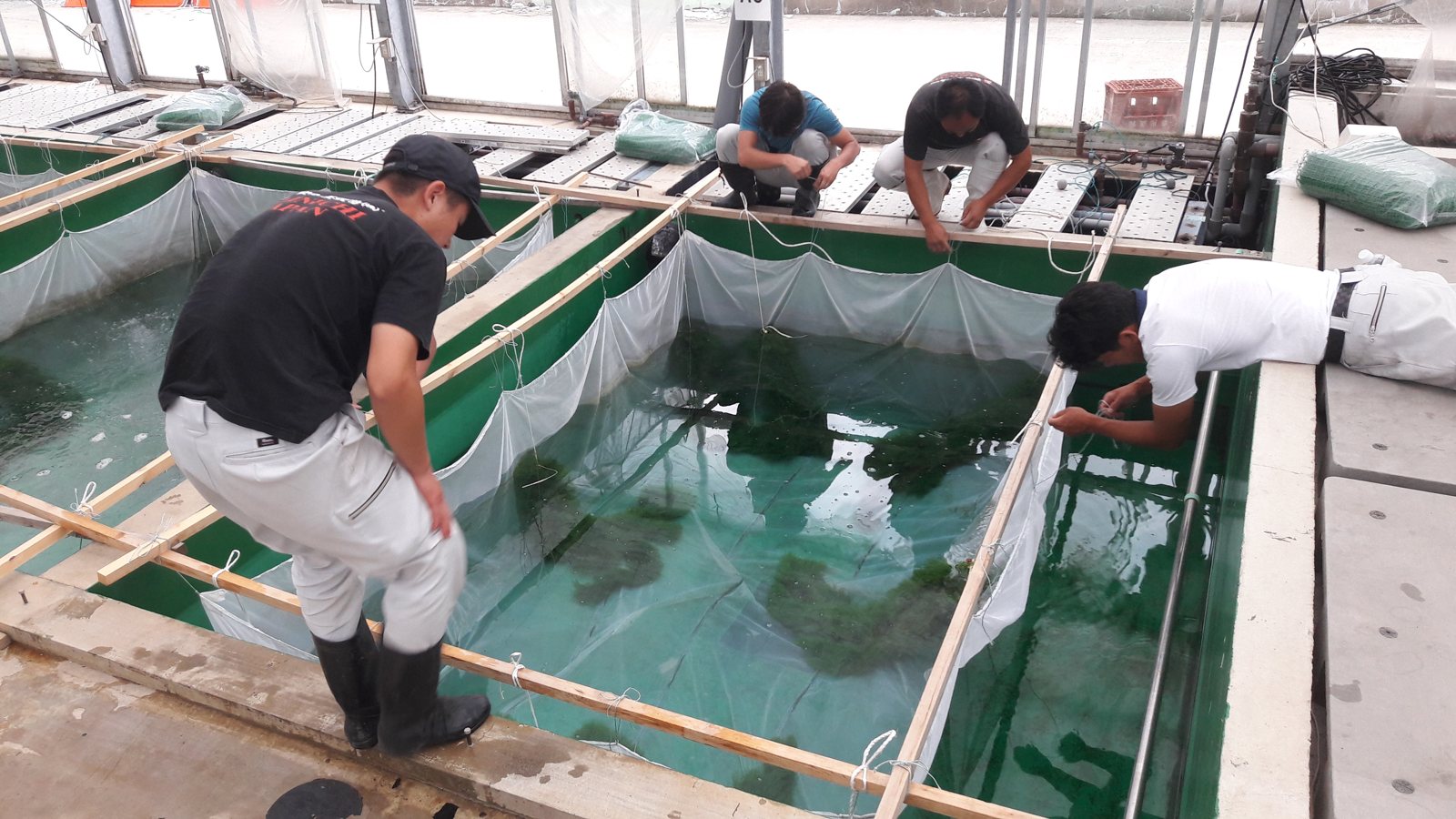
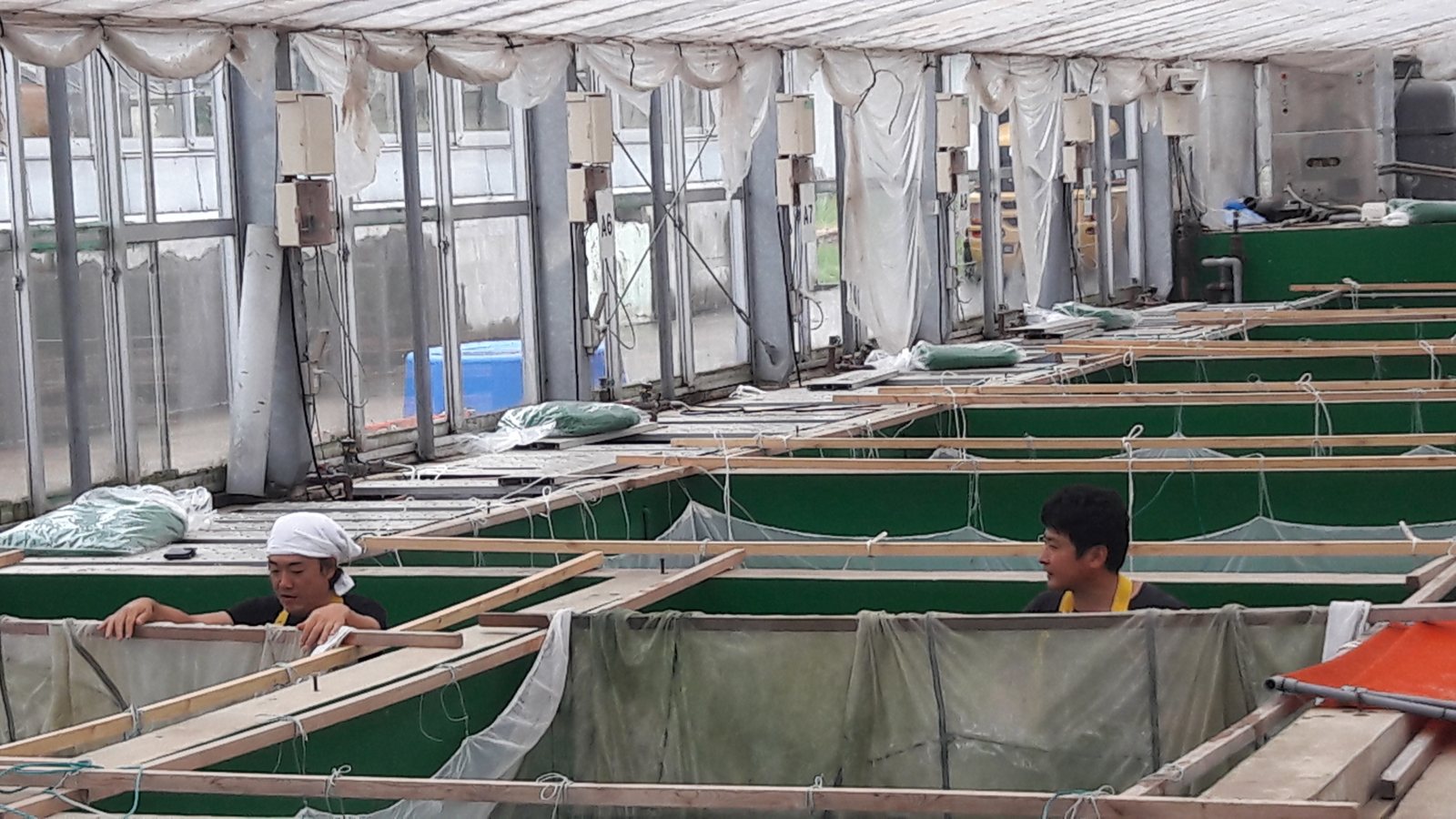
The parent fish are also selected during the day. The males are stripped: do they work, how much milt do they still give? Has one already been through one, two or three rounds? Many males are used in several pairings. After four or five days they usually have milt again, but each set is looked at afresh. If a particular male matters a great deal, work with it continues artificially, because that needs far less milt than natural spawning.
Bodybuilders on a diet
Each female is used only once a year, and yet nothing tires a fish as quickly as spawning season. The males wear themselves out, and afterwards the females are sometimes completely hollow, the whole body sunken, so many eggs have they released. Then they have to be built up again in clean, very warm water.
It is precisely the very voluminous, muscular fish that produce few eggs. They have to go on a diet beforehand and are fed more plant-based food rather than pellets so that they form enough eggs again. The super fish you see at a show is therefore never a good breeding fish at the same time. Only when it comes down from the bodybuilding does it become a fertile female.
The parent fish of 2019
In June 2019 printed photos of the parent fish hung on the spawning enclosures in the fish houses, and a poster introduced the females of the year: SHOGUN, DS Kohaku, Super Kohaku and Mona Lisa.
The Mona Lisa never took part in a show. She was shown once, in the Dream Area of the Shinkokai. Shigeru calls her a super Showa: not mainstream, because she is too black towards the rear and has too little red, but in head and body practically the ideal of Showa breeding. A huge face, a voluminous, broad body all the way to the back, a thick tail root and no paunch, plus a strong red, a deep black, a precise Motoguro and pectoral fins that could not be better. Everything that, for me, defines a fish.
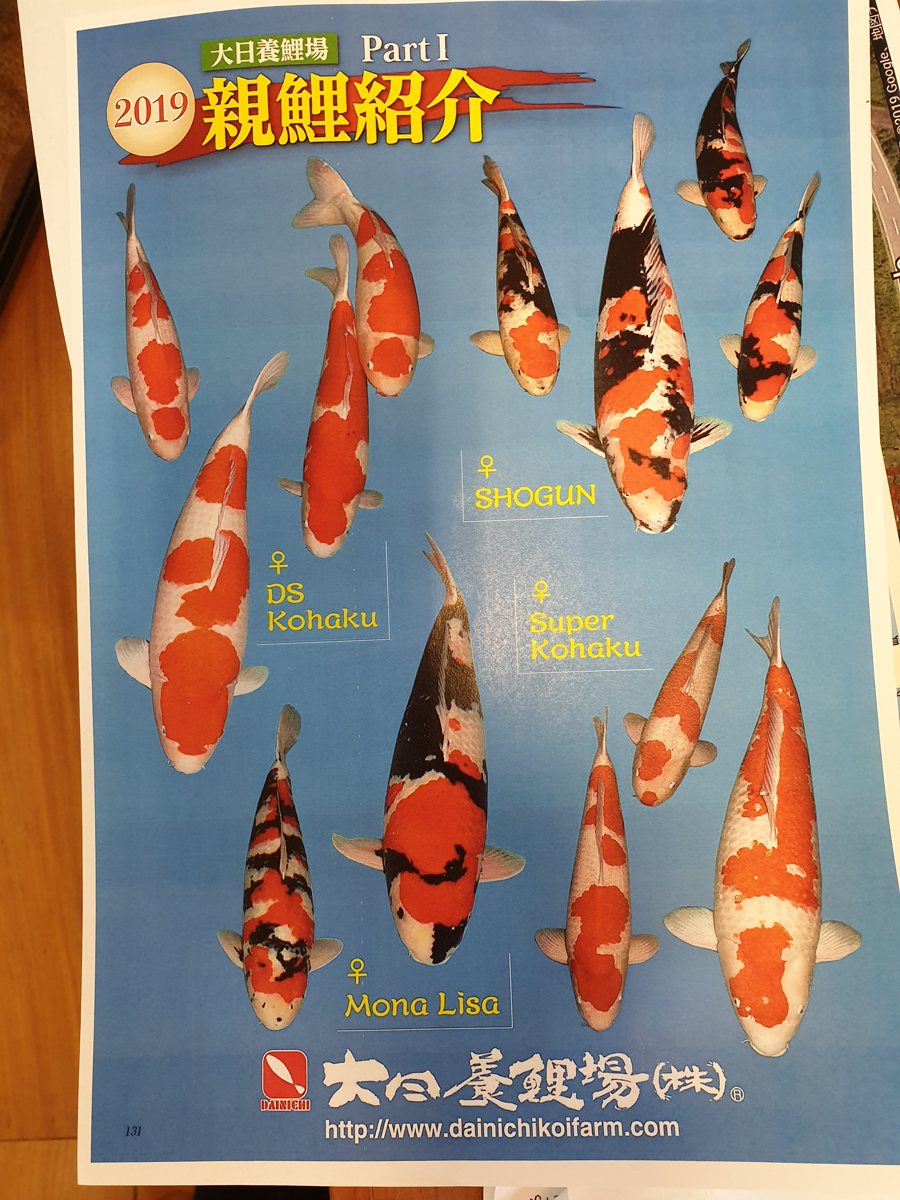
Behind her lies a whole series of considerations. On one side the Monster lines: Dainichi's traditional Showa line Gatchako, crossed with Showa offspring from Momotaro out of the line of the famous Lion Queen, Grand Champion of the All Japan 2014. That brought in outside, large-growing blood. On the other side GatchaX: Gatchako crossed with the Dainichi Kohaku Junior X, to pass its volume and Superbeni on to the Showa. From GatchaX and the Monster lines came the Mona Lisa, the best of all the lines in one fish. And that, I think, took Dainichi to the top of the koi world. Once again.
From spawn to larva
Outside the fish houses lie shallow, walled concrete basins of about 30 by 30 metres, with half a metre of water depth. The net enclosures are often moved there for incubation, and the larvae hatch outdoors. On each enclosure floats a block of polystyrene stating which pairing is inside. Dainichi is a farm with many Showa, and after just 48 hours the white larvae are separated from the black ones. If this selection doesn't go as quickly as wanted, they already get a little Cyclops and water fleas in the net enclosure.
The larva first lives off its yolk sac, then swims up and goes out into the larval pond. That pond has to be prepared for exactly this moment: first it needs algae, after the algae come the water fleas, and it all has to be timed so that there is enough food when the young fish get going. From zero to a hundred, so to speak.
Two weeks of spring, two weeks of autumn
If you want to understand spawning season in Niigata, you have to know the climate. Winter is long, longer than here. Spring lasts fourteen days, in which the snow melts away at record speed, and before you know it you are standing in a T-shirt at over 20 degrees. The long tug-of-war between zero and twelve degrees that we know hardly exists there. For the larvae in the shallow basins this means the water can quickly head towards 30 degrees.
Autumn is just the same. At the end of October the forest turns yellow and red, the Kōyō. You watch this colourful band run down from the mountains as if in a time-lapse, with the white band following right behind it. In the mornings mist rises from the ponds, which are still warmer than the air, and then you are standing in snow. Once, with my friend Harry Soßna, I sat on the steps of a restaurant in a T-shirt eating sushi outside. The next day we were standing in a snowstorm, and four or five days later there were three metres of snow. The Japanese were already up on the roofs clearing them so that nothing would cave in.
The parent fish are the last to be harvested each year, in the first week of November. We have stood in deep snow, and every half hour the lads went into the lorry, held their hands to the hot vents until they had feeling again, and then went back out to the seine net.
That not everything sinks into chaos is down to the ground: there is hardly any ground frost there. Winter hovers around freezing point, one or two degrees below zero at night, two or three degrees above during the day. The clouds come from Siberia over the still-warm Sea of Japan, soak up moisture and drop it as snow on the mountains. Every night half a metre thaws away at the bottom, and half a metre more snow falls on top. Nozzles are set into the middle of the roads that spray water onto the asphalt, and every flake melts at once. Only in the winter after the Chūetsu earthquake, when the pipes in the roads had been torn apart and it also turned unusually cold, did people drive over sheets of ice for days.
The ground soaks up all the meltwater like a sponge. That is why the mountains are full of water all year round, and this is what fills the pond terraces. This summer heavy rain came on top of that, and in some places terraces burst and the upper ponds poured into the lower ones.
Mud, minerals and a fine touch
Haaki had always thought that the mineral soil and the slightly cloudy water of the natural ponds were the secret of good skin. The assumption isn't wrong. Minerals pass from the soil into the water, and fine suspended particles and a little organic matter are kind to the mucous membrane. A bit of green in the water is needed too. But only light green water, not dark green pea soup. Otherwise the algae draw so much carbon dioxide out of the water that the lime precipitates, the buffer disappears and the pH swings up and down.
The water in the mountains is almost rainwater, with no hardness. Anyone who knows the craft can tell from the colour when a few shovels of fertiliser are needed and when to counter with lime. Some also use finely ground crustacean and mussel shells for this, a reddish powder that buffers and adds new minerals. That takes a fine touch, and it doesn't happen by itself.
Herons, birds of prey and bears
Part of the upkeep is keeping the banks short, so that no dirt collects on overhanging clumps of turf and you can see where you are stepping. Against herons the ponds are fenced off at the sides with nets, and above them run lines against birds of prey.
And then there are the bears. Anyone who knows my videos from Japan will have seen that they like to raid the automatic feeders. In the film I show a box hanging in front of a feeder that plays bird screeches, dogs barking and machine-gun fire. There I first explain with a straight face that this is the latest innovation from Japan: the koi are being accustomed to the sounds of the big city so that they become tamer. That is nonsense, of course. The box is meant to keep away the Asian black bear that lives in the mountains, so that it doesn't rob the feeder and scatter the food into the mudponds.
 Deutsch
 Nederlands
 English
 Français
 Italiano
 Español
 Português
 Română
 Polski